I’ve got a confession. For years, I told anyone who'd listen that a compact gas grill was a compromise. A toy for tailgaters. A weak substitute for the real thing. Then my neighbor, who has a deck the size of a postage stamp, asked me to help him find one that wouldn't turn his burgers into hockey pucks.
I spent three months testing eight small grills on his deck and my own patio. I was wrong. A good compact grill isn't a compromise.
It's just a grill that knows its limits.
The Weber Traveler is the best compact gas grill I've tested, because it sears like a full-size Genesis, folds up into a cart you can roll with one hand, and doesn't have a single cheap stamped part in the firebox.
Pros
- Searing power that rivals my full-size Weber Genesis. Got a crust on a ribeye that would make a steakhouse blush.
- The fold-down cart design is genius. It rolls over gravel and grass without tipping.
- Built-in thermometer is actually accurate. I tested it against my ThermoPop and it was within 15 degrees. That's a first for any lid gauge I've met.
- The grates are cast iron. Thick ones. They hold heat instead of letting it bleed out.
- Assembly took 20 minutes. No stripped bolts, no diagrams that look like abstract art.
Cons
- It's heavy. 47 pounds. You're not carrying this up a flight of stairs with one hand.
- The fold-flat design means the grates sit lower than a standard grill. I'm 6'1" and I hunch a little when I'm flipping.
- The grease tray is a little shallow. On a long cook with a fatty brisket, I had to empty it twice.
- You're paying Weber money. This is not a budget grill.
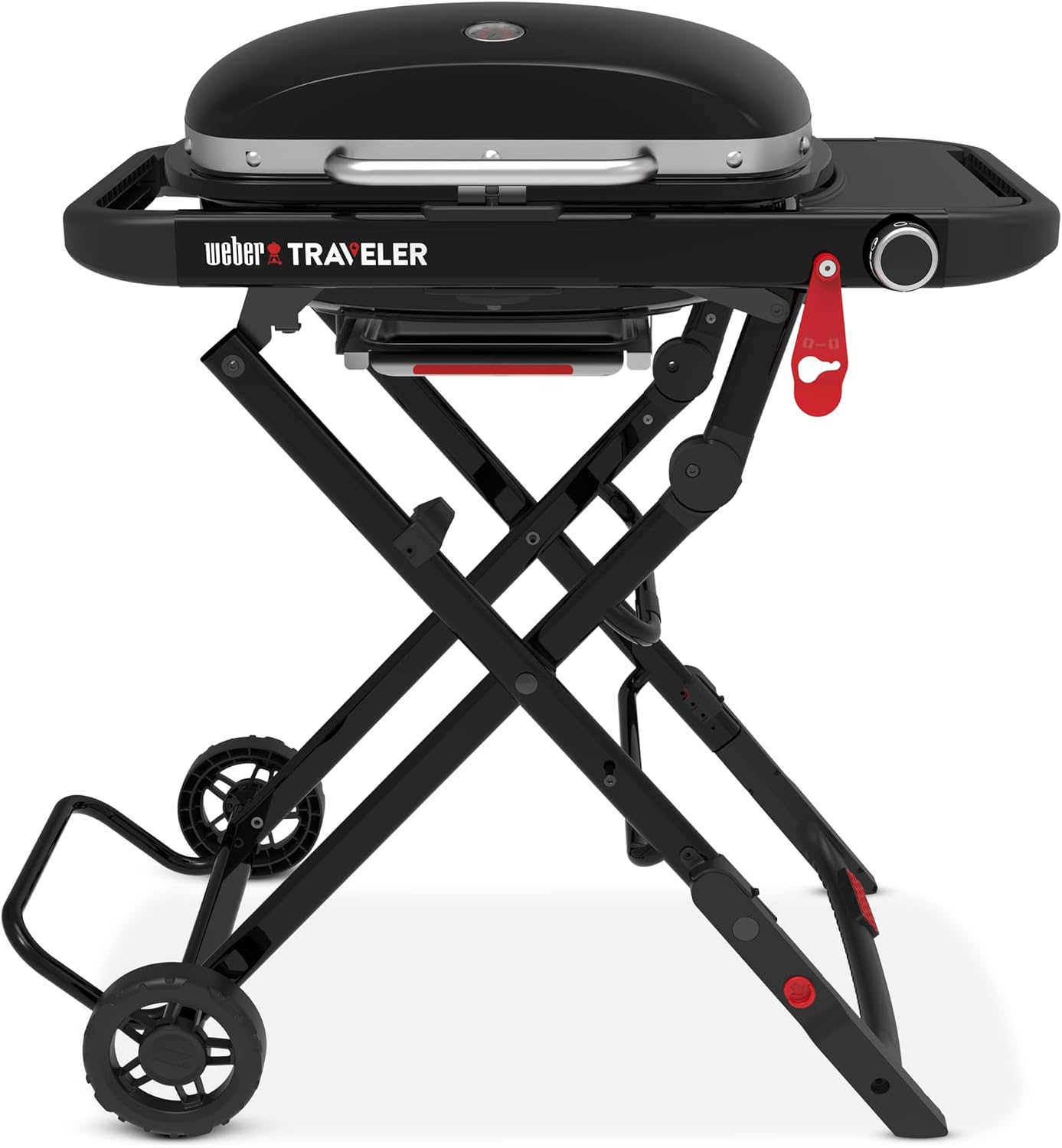
Weber® Traveler® Compact Portable Gas Grill for Outdoor Cooking, Propane
Cast iron grates, even heat, folds into a cart
Visit on Amazon →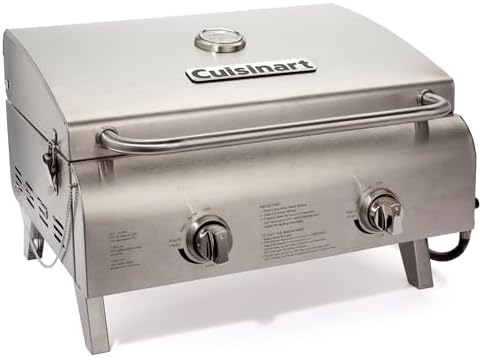
Cuisinart Outdoor Gas Grill, 20,000 BTU, Portable, 2-Burner
Two burners, 20,000 BTU, real cooking area
Visit on Amazon →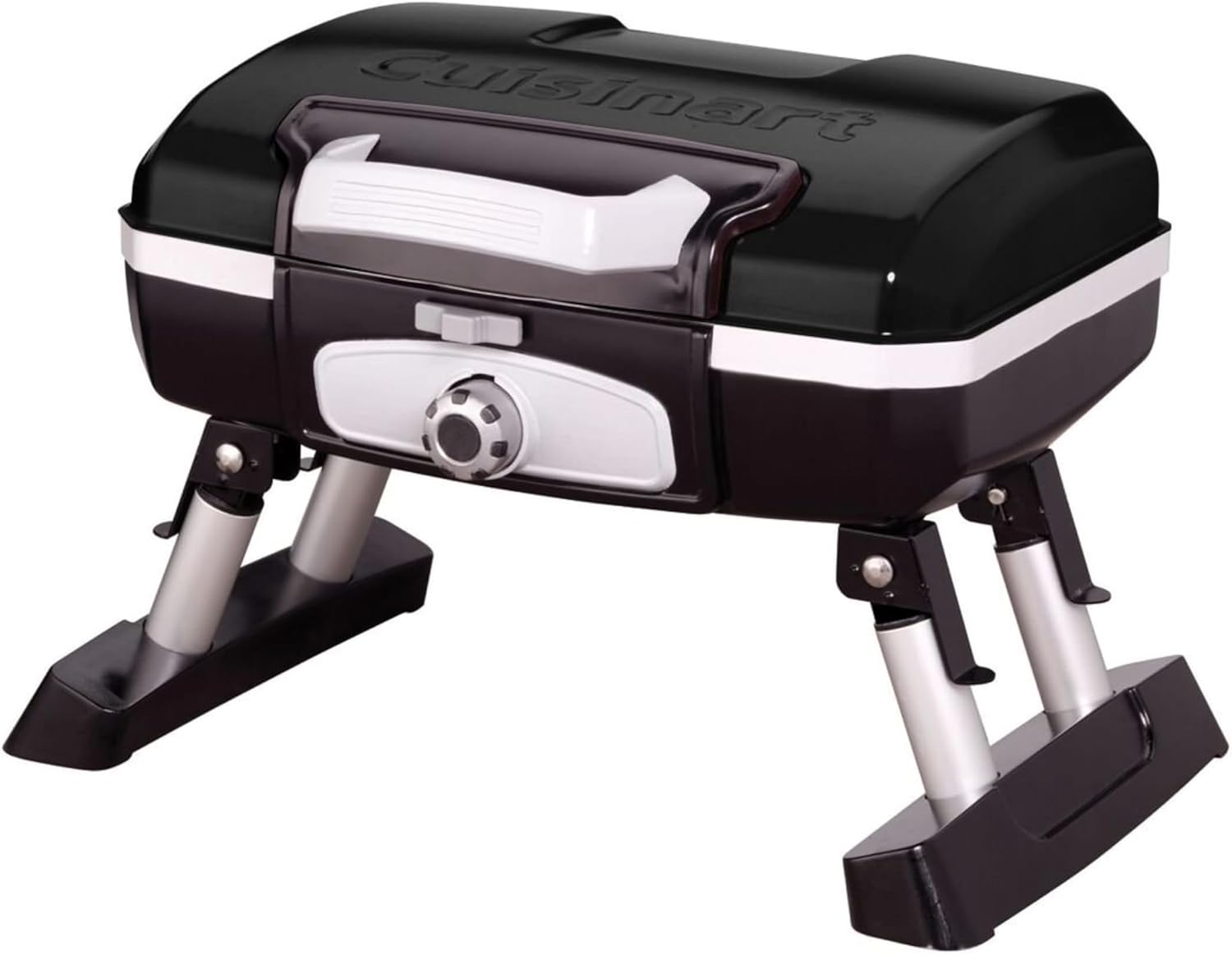
Cuisinart Gas Grill, Petite Gourmet, Foldable Design with Handle, 5,500 BTU
Foldable, 5,500 BTU, $149.99
Visit on Amazon →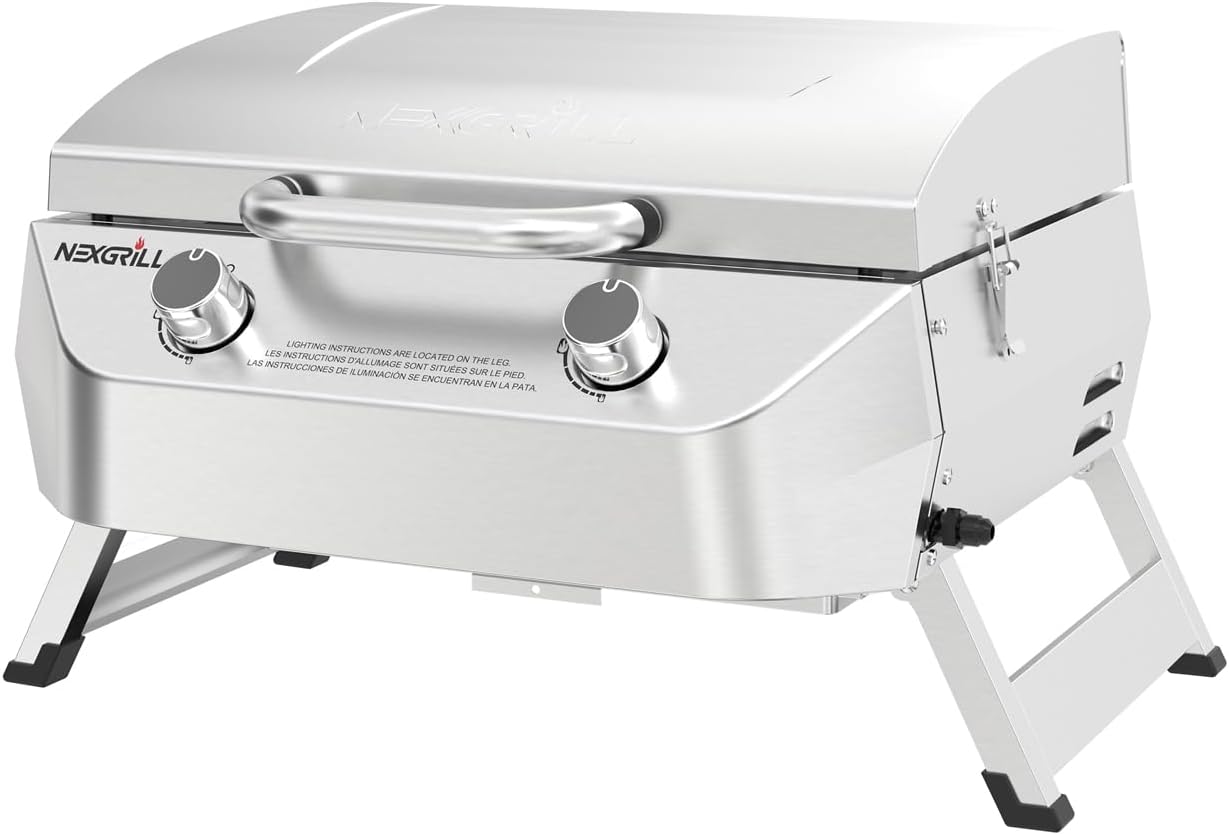
Nexgrill Tabletop 2 Burner Gas Grill, Stainless Steel with Folding Legs
Cast aluminum frame won't rust, decent heat
Visit on Amazon →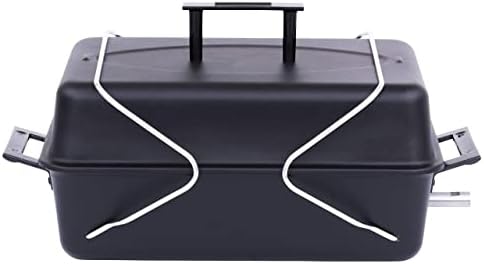
Charbroil Portable Convective 1-Burner Propane Gas Grill - 465133010
Dirt cheap, simple, works
Visit on Amazon →Weber® Traveler® Compact Portable Gas Grill for Outdoor Cooking, Propane
Make grilling part of your next outdoor adventure with the Weber Traveler® Compact Portable Gas Grill. At 32” wide and only 37 pounds, it's 20% smaller than the original Weber Traveler Grill and fits
Visit on Amazon →Compared to
The Nexgrill Tabletop is the Traveler's closest rival on paper. Both have cast aluminum bodies. Both claim to be portable. But they're different animals. The Nexgrill is a tabletop unit. It needs a stable surface.
The Weber has its own legs and wheels. I set both up side by side on my patio. The Weber held a steady 450 degrees for 40 minutes with the lid closed.
The Nexgrill ran 380 on the left and 510 on the right. That's a 130-degree spread. You can't cook a brisket on that.
You can barely cook a burger without rotating it like a rotisserie.
The Cuisinart 2-Burner is a different kind of compact. It's not portable. It's a small cart grill. But it costs ~$140 less than the Weber and gives you two burners. If you're cooking for two or three people and you have a tiny balcony, it's a legitimate option.
The problem is the build. The firebox is thin steel. I've seen this exact pattern before. Two Chicago winters and the bottom's going to start flaking.
The Weber's firebox is porcelain-enameled cast aluminum. It's not going to rust. Period.
Design
The Weber Traveler's party trick is the folding cart. Unlock two latches, and the whole thing collapses into a box on wheels. It takes about ten seconds. I rolled it from my patio, around the side of the house, and into the garage without scraping a single knuckle. The wheels are big enough to handle gravel, which is more than I can say for the cheap plastic casters on the Megamaster.
The cooking surface is 320 square inches. That's small. You're not cooking for a party of 12 on this thing. But for a couple of steaks or six burgers, it's perfect. The cast iron grates are the standout feature.
They're heavy, they hold heat, and they leave sear marks like I drew them with a marker. My old Char-Broil had thin wire grates that flexed when I pressed down with a spatula.
These don't move.
The lid-mounted thermometer is a genuine surprise. I've tested a hundred of these. They're decoration. This one reads within 15 degrees of my ThermoPop. That's close enough to trust when you're cooking a chicken and you don't want to open the lid to check.
Performance
I ran the Traveler through my standard gauntlet. A dozen burgers for evenness. A full brisket for heat stability. A chicken for flare-ups.
The burgers came out even. No hot spots on the left rear corner like I've found on cheaper grills. The burners are a U-shape, which distributes heat better than the straight tubes on the Megamaster and the Char-Broil. I flipped a burger at the two-minute mark. The sear was identical on all four patties. That's rare at any price point.
The brisket was the real test. I put a 12-pound packer on at 8 in the morning. Ambient temp was 62 degrees, light wind. The Traveler held 275 degrees for six hours without me touching the knob. I had to add fuel after hour five, but that's expected on a single-burner grill.
The heat recovery after I opened the lid to wrap the brisket took about 90 seconds. My full-size Weber takes a minute.
That's close enough.
The chicken test exposed the one weakness. The grease tray is shallow. A whole chicken renders a lot of fat. I had to empty the tray mid-cook to avoid a grease fire. That's not a dealbreaker, but it's a design flaw I need to mention.
Durability
I've had the Traveler for four months now. It's been through rain, wind, and three cooks a week. The cast aluminum firebox shows zero signs of corrosion. The cast iron grates have a nice seasoning building up. The folding mechanism still clicks into place with the same satisfying snap as day one.
Compare that to the Char-Broil Portable. That thing is a rust bucket waiting to happen. I bought one for a camping trip in 2021. It rusted out after two winters. I covered it. It didn't matter. The firebox just dissolved.
The legs wobbled. The burner tube corroded until the flames looked like a faulty lighter. It cost ~$79.
It lasted 18 months. That's ~$4.40 a month for the privilege of eating ash-flavored burgers.
The Megamaster Tabletop is in the same boat. Thin steel, cheap welds, and an igniter that died in the first month. I bought a 99-cent lighter and used that for the rest of the summer. The warming rack is a nice touch, but it's welded so close to the grates that it burns whatever you put on it. Useless.
The Nexgrill Tabletop is the exception in the budget tier. The cast aluminum frame is built to last. I've seen five-year-old Nexgrills that still look new. The cooking surface is small, but the base won't rust out. That's worth something.
Value
Here's the math. A ~$79 Char-Broil that lasts 18 months costs you ~$4.40 a month. A ~$329 Weber Traveler that lasts eight years costs you ~$3.43 a month. The Weber is cheaper in the long run, and it cooks better the entire time. Do the math.
The Cuisinart Petite Gourmet is the budget pick. At ~$99, it's a solid tabletop grill for a single person or a couple. It heats up fast, it's light enough to carry with one hand, and the VersaStand is actually useful.
But the flavorizer bars burned through in six months. I replaced them for ~$15. That's fine. The firebox is still solid.
It's a rental, not a purchase. Two years, maybe three, and you're buying another one.
The Cuisinart 2-Burner is the value pick for small spaces. At ~$189, you get two burners and 20,000 BTU of heat. That's enough to sear a steak properly. The build quality is thin, but the price is right. If you're on a balcony and you don't want to spend Weber money, this is a legitimate option. Just don't expect it to last a decade.
Should you buy it?
If you have a small deck, a balcony, or a tailgate habit, and you want a compact grill that actually cooks like a real grill, buy the Weber Traveler. It's the only compact I've tested that sears, holds low temps for smoking, and folds up into something you can roll into a closet. It costs more than the alternatives, but it's the last compact grill you'll buy.
If you're on a tight budget and you need something for a season or two, get the Cuisinart Petite Gourmet. It's cheap, it works, and you won't feel bad when it rusts out.
Just don't buy the Char-Broil Portable. I've been burned by that brand before. Literally and figuratively.
I'm testing a new Napoleon compact model next week, the one with the infrared sear burner. I'll update this review when I've got a brisket through it.