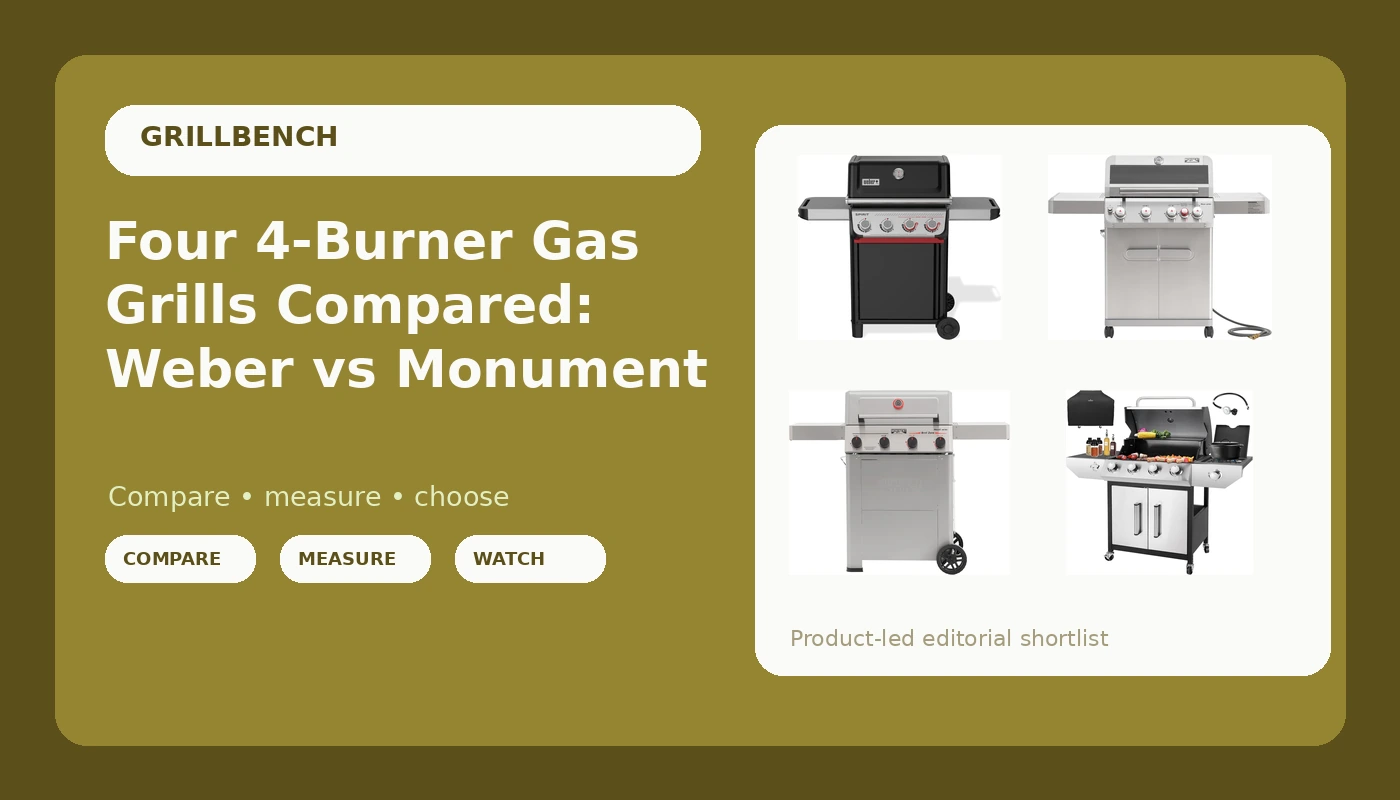
I have judged barbecue on a circuit for twelve years and cooked restaurant lines for fifteen before that, so I walk into grill shopping with a scoring card already in my head. When somebody asks me which 4 burner gas grill to buy, I start in the same place I start at a competition table: where the burners sit, and what the steel does when the lid comes down. Badges and BTU claims come last. A 53,000 BTU grill and a 50,000 BTU grill are the same thing on paper until you watch where the heat actually lands and which corner of the grate burns the first burger.
Related: Propane Vs Natural Gas Grills: What Actually Changes On The Cook
For most patios, the Weber Spirit E-425 is the 4 burner gas grill I would spend my own money on, because burner layout and warranty are the two things you cannot fix later with an accessory. The Monument Mesa II 410FBZ is the value pick. The Monument 4+1 natural gas model is the right answer if you already have a gas line run to the patio. The budget stainless four-burner is the one I would only buy with a return policy in hand.
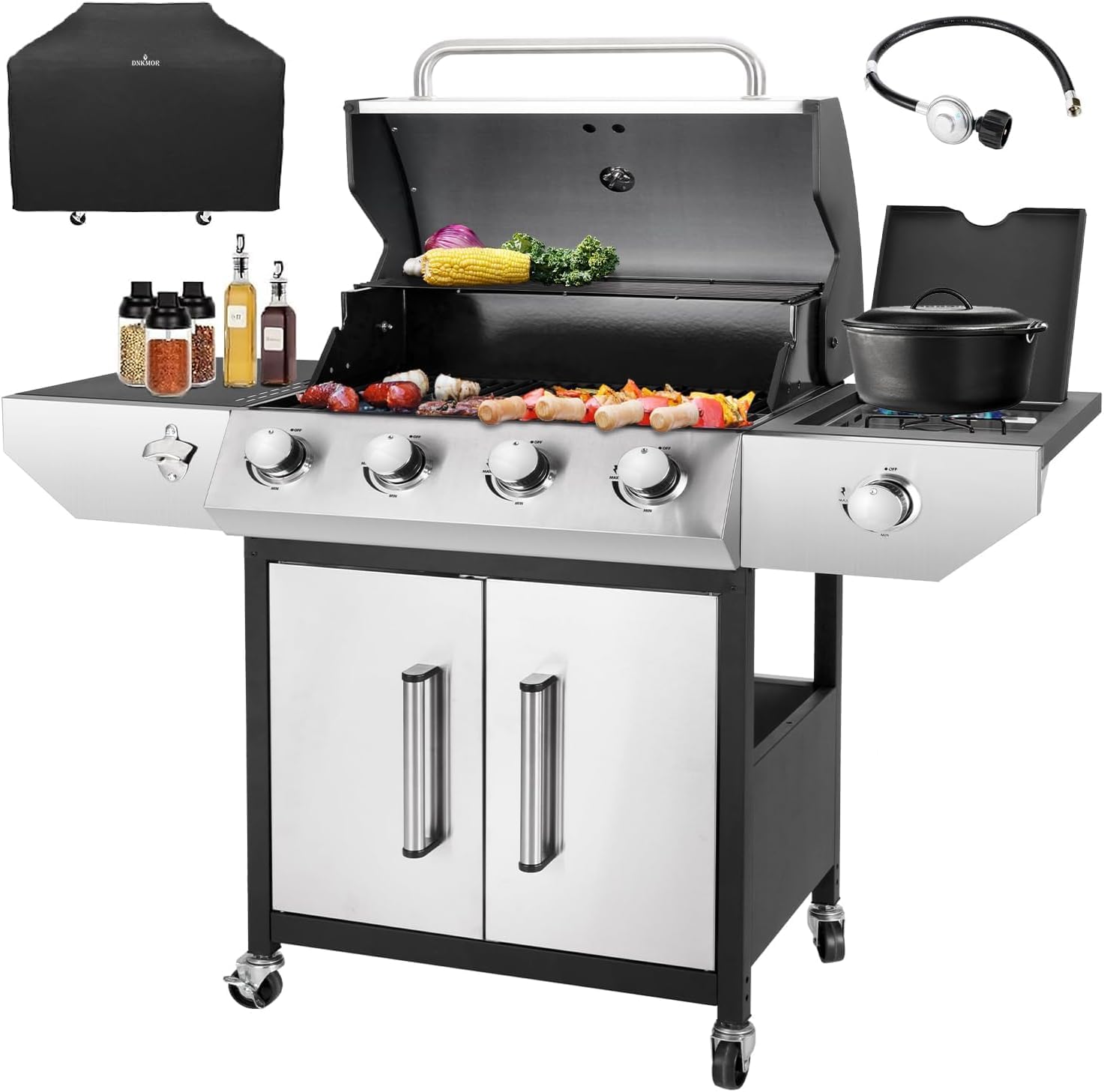
4-Burner Propane BBQ Grill 53000 BTU Stainless Steel Cast Iron Grate
Cast iron grates hold heat and sear hard, big BTU headroom, front to back four-burner layout
Unproven igniter and cart at this price, no side burner, the shortest warranty of the group
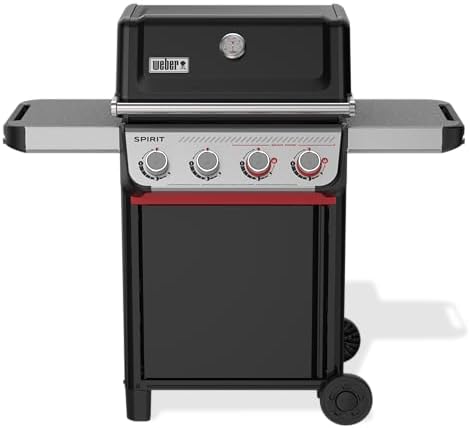
Weber® Spirit® E-425 Gas Grill, Outdoor Cooking, Propane Gas Grill, Black
Best burner warranty in this group, the most reliable igniter, predictable heat cook after cook
Highest cost of the four, modest sear ceiling, side tables are small
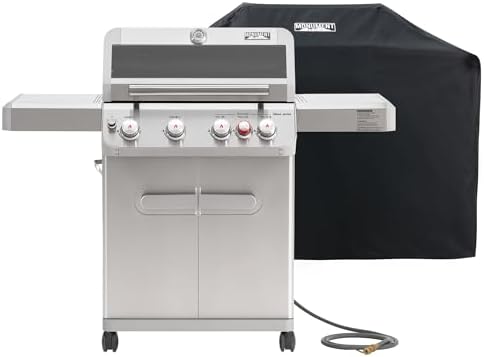
Monument Grills 4+1 Burner Natural Gas Grill with Natural Gas Hose, 50,000 BTU Stainless Steel Outdoor Patio Barbecue Grill, Broil Zone Fast Heating, Knob Lights, and Easy Cleanup, M415BZNG
Runs on a gas line so there are no tank swaps, 50,000 BTU, dedicated broil zone, knob lights
Needs a natural gas stub and a fixed spot, plus one burner you may never light
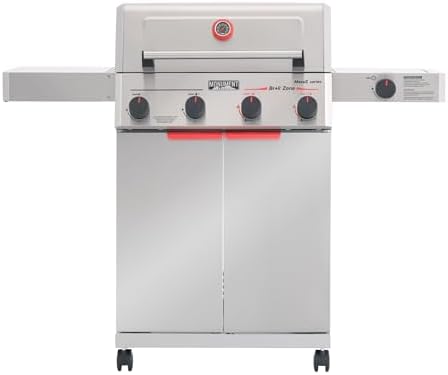
Monument Grills 4 Burner Propane Gas Grill with Advanced Broil Zone, Stainless Steel Outdoor Mesa 2 Barbecue Grill, Foldable Side Shelves, 500°F in 5 Mins, Fast Assembly, Mesa II 410FBZ
Foldable side shelves, propane portability, broil zone, fast assembly
A tank to manage, thinner stainless at this price, the 500°F claim needs verifying
Prices and availability were captured from Amazon Creators API and may change.
How I score a grill
Every grill that comes through my bench gets three cooks before I form an opinion. A dozen burgers spread across the grate finds the hot spots in ten minutes. A packer brisket tells me whether the thing holds 350 for an hour without babysitting. A whole chicken, skin side down, tells me whether the grease management keeps up or whether dinner turns into a fire drill. I log ambient temperature and wind in a spiral notebook beside the cook, because a grill that performs in a still backyard and falls apart in a gust is not one I can recommend.
My card has six lines: flare control, recovery time, evenness, igniter, cleanup, warranty. Not one of them is a BTU number. BTU tells you how much gas the burners can eat. It does not tell you where the heat lands, and where the heat lands is engineering.
Burner layout decides everything
Four burners is the configuration I recommend to nearly everyone. Three is tight the moment you add a side dish, because your two-zone setup collapses as soon as one burner is holding corn. Four gives you a hot side, a cool side, and a spare for a drip pan. Five and six burner carts are wonderful if you feed a crowd every weekend, and a waste of propane for the rest of us.
What matters more than the count is the spacing. On a four-burner cart I want the tubes running front to back so I can slide a steak from the sear zone to the cooler side without moving it across the yard. All four grills here follow that geometry, which is a good start. The rest is how much of the grate sits directly over a burner and how much sits over dead space between tubes. That is where hot spots are born, and no spec sheet will tell you.
Weber Spirit E-425: the boring answer, and I mean that as a compliment
Weber does not win spec sheet arguments, and it has never tried to. The Spirit E-425 is propane, four burners, black porcelain enameled steel, and it looks like every Spirit that has sat on a patio for a decade. What it has that nothing else here has is burner coverage measured in years rather than seasons. The 10-year burner warranty is the most valuable line on any of these four spec sheets, and it is the reason I keep pointing people at a grill that costs considerably more than the budget model.
The second thing Weber gets right is the igniter, which is my most common complaint in this category. A grill that needs a long lighter by week three is going back, and Spirit igniters are the ones I have replaced least often.
What you give up is sear ceiling. The E-425 turns out excellent burgers, chicken, and a spatchcocked bird without drama, and it is not the grill I would pick to crust four steaks at once. The side tables are functional rather than generous. If a hard sear is the reason you are shopping, the broil zone on the Monuments is the more interesting piece of engineering. If you want to buy once and stop thinking about it, this is the one.
Monument 4+1 natural gas: buy it for the fuel line
The 4+1 burner natural gas model is the only grill here that ships with a natural gas hose, and that single detail changes how you live with it. No tank to swap mid-brisket, no trip to the filling station on a Sunday afternoon, no lifting the tank and doing math to guess how much propane is left. If you have a gas stub at the patio, this is the grill that removes the worst chore in propane cooking.
Fifty thousand BTU across the main burners is plenty for a four-burner cart, and the broil zone gives you a defined high-heat area for steaks and quick sears. The knob lights sound like a gimmick until you are cooking in the dark in November, and then they are the feature you use every single time.
The trade-offs are real. Natural gas means the grill lives where the line is, so no rolling it to the other side of the yard. You either have a stub or you are paying a plumber, and that cost never shows up on the listing. The plus-one burner on a cart in this class is usually a side burner, so confirm what that fifth burner actually is before you commit. A side burner you never light is not worth paying for.
Monument Mesa II 410FBZ: the value pick
The Mesa II runs on propane, so it moves. Four burners, a broil zone, foldable side shelves, and a manufacturer claim of 500 degrees in five minutes. Foldable shelves are the detail I appreciate most, because a lot of patios are tight and a cart that narrows down is easier to live with than one that does not. Fast assembly is the other claim worth having, since a grill you resent putting together is a grill you use less.
On that temperature number: 500 degrees in five minutes is a manufacturer figure, and I would verify it with an ambient thermometer on the first cook rather than take it on faith. Every brand in this price band says something similar, and the honest ones are the ones where the number holds in a light breeze. The broil zone is the more meaningful spec, because a defined sear area is what separates a grill that sears from a grill that merely cooks.
What you accept at this price is propane tank management and stainless that is likely a thinner gauge than the Weber. Keep it covered and it will hold up. Leave it in the weather and stainless in this band will tell on you.
The budget 53,000 BTU stainless four-burner: the gamble
The cheapest grill in this group also has the loudest spec sheet. Fifty-three thousand BTU, stainless body, cast iron grates. The grates are the part I like. Cast iron holds heat and gives a better crust than thin porcelain wire, and it is the right material for a sear. The BTU number is the part I ignore. BTU is the cheapest thing a manufacturer can print on a box, and a 53,000 BTU burner set with sloppy spacing will show worse hot spots than a well-built grill with a smaller number.
What I would check in the first two weeks: the igniter, the burner tubes for uneven flame, and whether the cart wobbles once a tank is sitting in it. At this price the money went to the burners and the body, and something had to give. Usually it is the igniter, sometimes it is the side tables, often it is the warranty. That is not a reason to avoid it. It is a reason to buy it somewhere with a return policy and to test it hard while you still can.
Propane or natural gas
This decision should come before the brand, because it is the one thing you cannot change with a wrench and an afternoon. Propane means portability, a tank to manage, and no installation cost. Natural gas means a fixed location, a line you either have or have to pay for, and then unlimited cooking with no refills ever again. Two of the four grills here are propane, one is natural gas, and one is propane only.
My rule: if you have a gas stub on the patio, buy the natural gas grill and never think about fuel again. If you do not, buy propane and buy a spare tank, because running out mid-cook is the most avoidable bad night in backyard cooking.
Igniters, grates, and side tables
Three details decide whether you still like a grill in year two, and none of them are BTU.
The igniter comes first. A dead igniter turns a two-minute start into a five-minute chore with a lighter, every time you cook, for the life of the grill. Ask how it is powered and how easy it is to replace.
Grates come second. Cast iron holds heat and sears better, but it rusts if you neglect it. Porcelain coated steel is lighter and easier to maintain, and it does not sear quite as hard. Both are fine. Neither is fine if it is thin.
Side tables come third, and this is where expensive grills quietly fail. A side table smaller than a dinner plate is not a side table, it is a shelf for a spatula. If you prep outside, look at the tables before you buy.
Who should buy which
- Buy the Weber Spirit E-425 if you want the longest burner warranty in the group, a reliable igniter, and you would rather pay once than replace a grill in five years.
- Buy the Monument 4+1 natural gas model if you have a gas line at the patio and want to stop thinking about tanks forever.
- Buy the Monument Mesa II 410FBZ if you want a broil zone, propane portability, and foldable shelves at the value end of the group.
- Buy the budget 53,000 BTU stainless four-burner if budget is the constraint and you want cast iron grates, as long as you test the igniter early and cover the cart.
What I am testing next
Flare-up control is the claim I am chasing this year. Four brands have told me their grates are flare-free, and so far one of them is telling the truth. The pattern I keep finding is that grease management matters far more than grate geometry, and the grills that handle drippings well are the ones with a tray you can actually reach and clean. I will have numbers on that soon.
The bottom line
Four burners, front to back burner tubes, and a warranty you can read without squinting. Everything else is marketing. The Weber is the safe money. The natural gas Monument is the right grill for the right patio. The Mesa II is the value pick. And the budget stainless four-burner is a real grill with real compromises, which is exactly what the price tells you if you read past the BTU number.