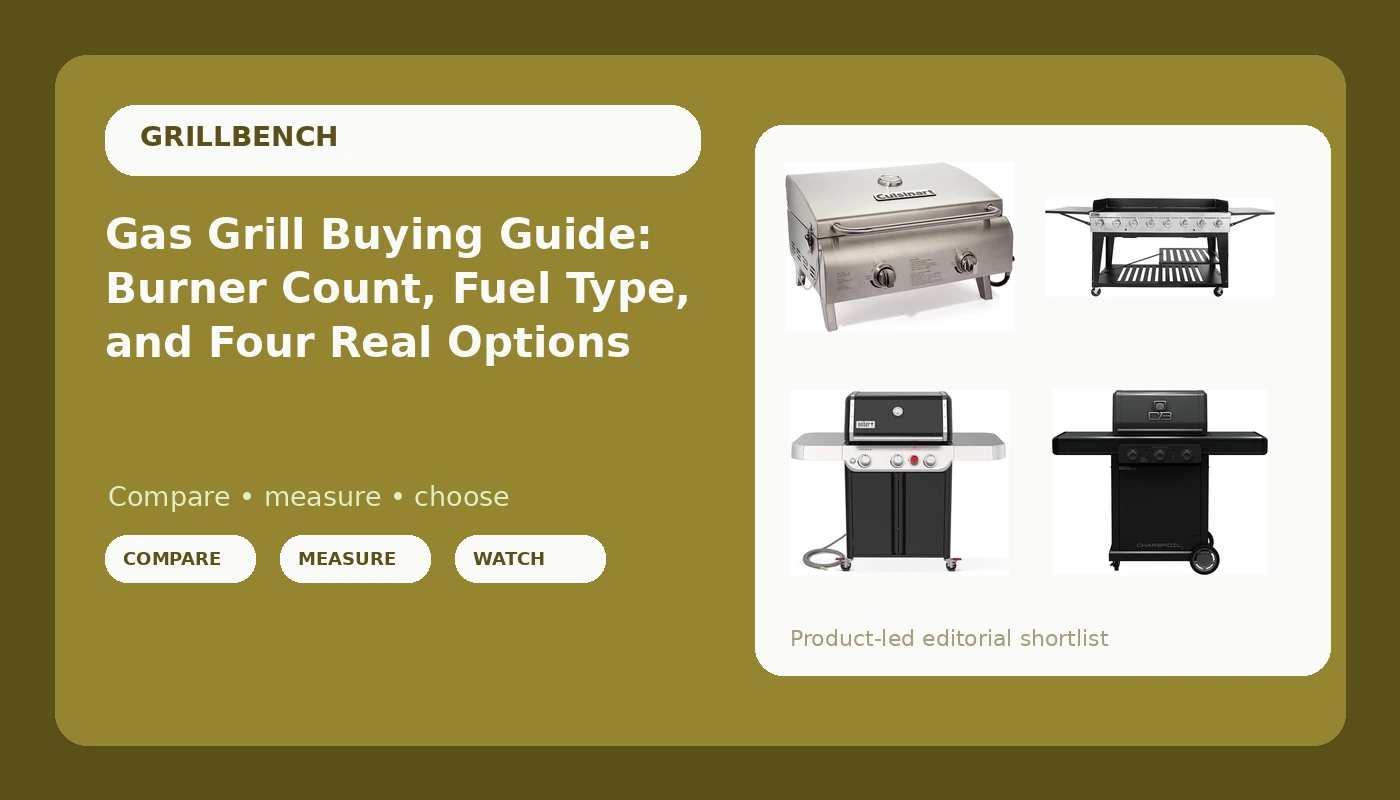
A gas grill is one of the few outdoor purchases where the spec sheet and the real cooking experience can disagree so completely. The number printed largest, total BTU output, says almost nothing about how evenly a grill cooks or how fast it recovers after you open the lid. This gas grill buying guide sorts the numbers that matter from the ones that are marketing, then looks at four specific grills at four different sizes and jobs: a portable two-burner, a mid-size three-burner propane unit, a natural gas model, and an eight-burner grill built for a crowd.
Related: Propane vs Natural Gas Grills: What Changes at the Hookup →
Quick answer
Start with fuel and footprint, not BTU. If a natural gas line already reaches your patio, a natural gas grill removes tank refills from your life entirely. If you cook for two to six people on a deck, a three-burner propane grill covers most meals. If you move the grill or store it between cooks, a portable two-burner is the practical answer. If you regularly feed a dozen or more, an eight-burner unit gives you the surface area to do it, at the cost of fuel, space, and assembly time.
Four useful options
| Model | Best fit | What stands out |
|---|---|---|
| Royal Gourmet 8-Burner Gas Grill, 104,000 BTUs Liquid Propane Grill | Large cooks and parties | Eight main burners and a 104,000 BTU manufacturer rating on propane |
| Cuisinart Outdoor Gas Grill, 20,000 BTU, Portable, 2-Burner | Small patios, balconies, travel | Portable two-burner format with the smallest footprint here |
| Weber® Genesis E-325 Gas Grill for Outdoor Cooking, Natural Gas, Black | Patios with an existing gas line | Natural gas configuration, three-burner Genesis body, long published warranty coverage |
| Charbroil Pro Series with Amplifire Technology 3-Burner Propane Gas Grill and Griddle Cabinet, Black - 463365124 | Everyday family cooking plus griddle work | Three propane burners, a griddle, and a cabinet base |
The big-crowd option: Royal Gourmet 8-Burner Gas Grill, 104,000 BTUs Liquid Propane Grill
The trade-off with a grill this size is everything around the cooking. Eight burners consume propane faster than two or three, so plan on more tank swaps or a spare tank on hand. The unit also takes up real patio space and typically arrives as a flat-pack assembly project, which is an afternoon rather than twenty minutes. More burners also does not automatically mean more even heat; burner layout and tube design still decide where the hot spots land. If your typical cook is four burgers, this is more grill than you need. If your typical cook is a party, it is the one here that will not run out of room.
The portable option: Cuisinart Outdoor Gas Grill, 20,000 BTU, Portable, 2-Burner
Twenty thousand BTUs spread across two burners is a modest amount of heat, and that shapes what this grill is good at. It will handle burgers, sausages, chicken pieces, and vegetables for a few people. It is not the grill for a whole brisket or a dozen steaks at once, because the food will not fit and the burners cannot drive that much surface evenly. What you get in exchange is a grill one person can move, store in a garage or closet, and take to a park or campsite. If you rent, move often, or grill on a balcony with a hard limit on size, this is the category that fits. Buy a cover sized to it, because portable grills that sit outside uncovered do not last.
The natural gas option: Weber® Genesis E-325 Gas Grill for Outdoor Cooking, Natural Gas, Black
Natural gas is the quiet luxury of grilling. You never run out mid-cook, you never haul a tank to a refill station, and you never wonder whether the spare is full. The catch is that it only works where the plumbing already reaches. A natural gas grill needs a line and a shutoff, usually installed by a licensed plumber, and it stays where it is connected. It is also fuel-specific hardware, so you cannot convert a propane grill to natural gas with a different hose; the orifices and regulator are set for one fuel. On warranty, Weber's published terms for the Genesis line run long on major components, which matters more than any badge when a burner or cook box fails in year six. Read the current warranty document on the listing rather than trusting a memory of it.
The mid-size option: Charbroil Pro Series with Amplifire Technology 3-Burner Propane Gas Grill and Griddle Cabinet, Black - 463365124
This is the shape most households end up with: three burners, propane, enough surface for a family meal plus leftovers. The griddle is the interesting part, because a flat top handles smash burgers, eggs, and small vegetables that fall through a grate, which gives you a second cooking style without a second appliance. The cabinet base keeps tanks, tools, and covers out of sight. Flare-up claims deserve scrutiny: fat dripping onto hot metal will smoke and burn no matter what the grate is called, and the honest test is a batch of chicken thighs over a hot zone. Look for owner reports about grease management and cleanup before you commit.
Prices and availability may change. Product images, names, and retailer links are matched to verified listings. No current price, rating, stock status, or measured result is stated here without current evidence.
What BTU ratings and burner counts really tell you
BTU is a measure of energy input, not cooking performance. A grill rated at 104,000 BTUs is not automatically better than one rated at 20,000; it is a larger appliance burning more fuel per hour. What matters is heat density: total BTUs divided across the cooking surface, plus how the burners are arranged underneath it. A small grill with two well-placed burners can sear better than a wide grill whose heat is spread thin across a long firebox.
Burner count is really a statement about zones. One burner means one temperature. Two burners give you a hot side and a cooler side, which is enough for two-zone cooking and for sliding food away from a flare-up. Three burners let you run a hot sear zone, a medium zone, and an indirect zone at the same time, which is what most recipes quietly assume. Eight burners give you a very wide version of that, plus the ability to cook different foods at different temperatures across one long surface.
What no spec sheet tells you is evenness. Burner tube shape, the spacing between tubes, the material and thickness of the grates, and how the firebox handles airflow all decide where the hot spots land. That is why recovery time, how fast the grill returns to temperature after you open the lid, is a more honest indicator than peak BTU. A grill with a heavy lid and a tight firebox comes back quickly; a thin one loses its heat and takes a while to climb back.
Manufacturer BTU figures are total input ratings, usually for the main burners combined, and they assume the regulator and fuel supply deliver as designed. Treat them as a size indicator, not a performance promise.
Fuel, hookup, and the space you actually have
Propane is the default because it works anywhere. A standard tank, a regulator, and a hose, and you are cooking. The costs are refills, storage, and the risk of running dry mid-cook, which a spare tank solves. Propane grills are also movable in a way natural gas grills are not, which matters if you rent, relocate, or want to wheel the grill to a different spot on the patio.
Natural gas trades flexibility for convenience. If your home already has a gas line at the patio, a natural gas grill removes tank handling entirely and generally costs less per hour of cooking. If the line is not there, you are paying for a plumber and possibly a permit before you pay for the grill. Natural gas grills are fuel-specific: the orifices and regulator are set for natural gas, so you cannot run one from a propane tank or convert a propane model without the manufacturer's conversion kit, if one exists for that model.
Footprint is the constraint people underestimate. Measure the patio or deck, then add clearance on all sides and room behind the lid to open fully. A large grill also needs space to store a tank and, ideally, a cover. Check whether the grill will sit under an overhang or against a wall, and whether wind will hit it, because wind is the single biggest cause of temperature swings on an exposed patio.
Finally, think about assembly and parts. Bigger grills arrive in more pieces and take longer to build. Before buying, confirm that the brand sells replacement burners, igniters, and grates for the model, because a grill you can repair is a grill you keep.
Five checks before you buy
- Count the people you actually cook for, not the party you imagine hosting.
- Confirm the fuel you can really use: a propane tank you can refill, or a natural gas line already at the patio.
- Measure the spot, including clearance for the lid, the tank, and airflow around the unit.
- Read the warranty document and note what is covered and for how long, especially the burners and the cook box.
- Check that replacement parts and the owner's manual are available for the exact model before you order.
Practical guidance for the first season
- Preheat with the lid down for ten to fifteen minutes before food goes on, so both the grates and the firebox come up to temperature.
- Set up two zones even on a small grill: one burner high for searing, another low or off for finishing and resting.
- Keep a spare propane tank if you grill on propane; running out at minute twenty is the most avoidable failure in grilling.
- Clean the grates and empty the grease management system after rich cooks, since built-up fat is what turns a small flare into a big one.
- Buy a cover sized to the grill and use it, and inspect the igniter and burner tubes at the start of each season.
Which option should you choose?
Choose the Royal Gourmet 8-Burner Gas Grill, 104,000 BTUs Liquid Propane Grill when you cook for crowds and have the patio space and propane supply to feed eight burners. Choose the Cuisinart Outdoor Gas Grill, 20,000 BTU, Portable, 2-Burner when portability, storage, and a small footprint matter more than surface area. Choose the Weber® Genesis E-325 Gas Grill for Outdoor Cooking, Natural Gas, Black when you have a natural gas line at the patio and want to stop dealing with tanks. Choose the Charbroil Pro Series with Amplifire Technology 3-Burner Propane Gas Grill and Griddle Cabinet, Black - 463365124 when you want a mid-size propane grill with a griddle for a second cooking style.
None of these grills were measured or tested for this article; the details come from the product listings and the manufacturers' own naming, and the BTU figures are manufacturer ratings. Cooking evenness, flare-up behavior, and durability vary with fuel supply, wind, and how you cook. Verify dimensions, fuel type, and warranty terms on the current listing before ordering, and read owner reports for the specific model you are considering.
The bottom line
Fuel first, footprint second, burner count third. That order solves most gas grill decisions, because a grill that cannot connect to your gas supply or fit your patio is the wrong grill no matter how well it cooks. For most households with a deck and a propane tank, a three-burner grill covers the cooking. The Cuisinart portable handles small spaces and travel, the Weber Genesis E-325 is the natural gas answer where a line already exists, the Charbroil Pro Series adds a griddle to the mid-size propane format, and the Royal Gourmet 8-Burner is the one to consider when the guest list is the whole point. Check current Amazon price on any of them before you commit, and confirm the fuel configuration on the listing, because propane and natural gas versions of the same grill are different products.