Related: Best Gas Grill Under $500 for Actual Weeknight Cooking
Gas grills and griddles get sold on numbers that do not survive the first cook. BTU figures. Grate thickness claims. "Restaurant-grade" stamped on a cart that costs less than a dinner for four. I spent fifteen years on the line and twelve more judging barbecue, and the only spec that has ever predicted how a grill behaves in my own backyard is burner layout. Where the burners sit, what shape they are, and whether the fire comes back after you open the lid.
So this is not a spec sheet translation. This is four pieces of gear I would put in front of somebody building an outdoor cooking setup from scratch: a natural gas workhorse with a sear zone that actually works, a flat-top griddle for everything a grate cannot do, a budget propane grill that gets the fundamentals right, and the one tool that keeps all three alive past July. Read the sections, then use the reference table at the bottom to sort out which one belongs on your patio.
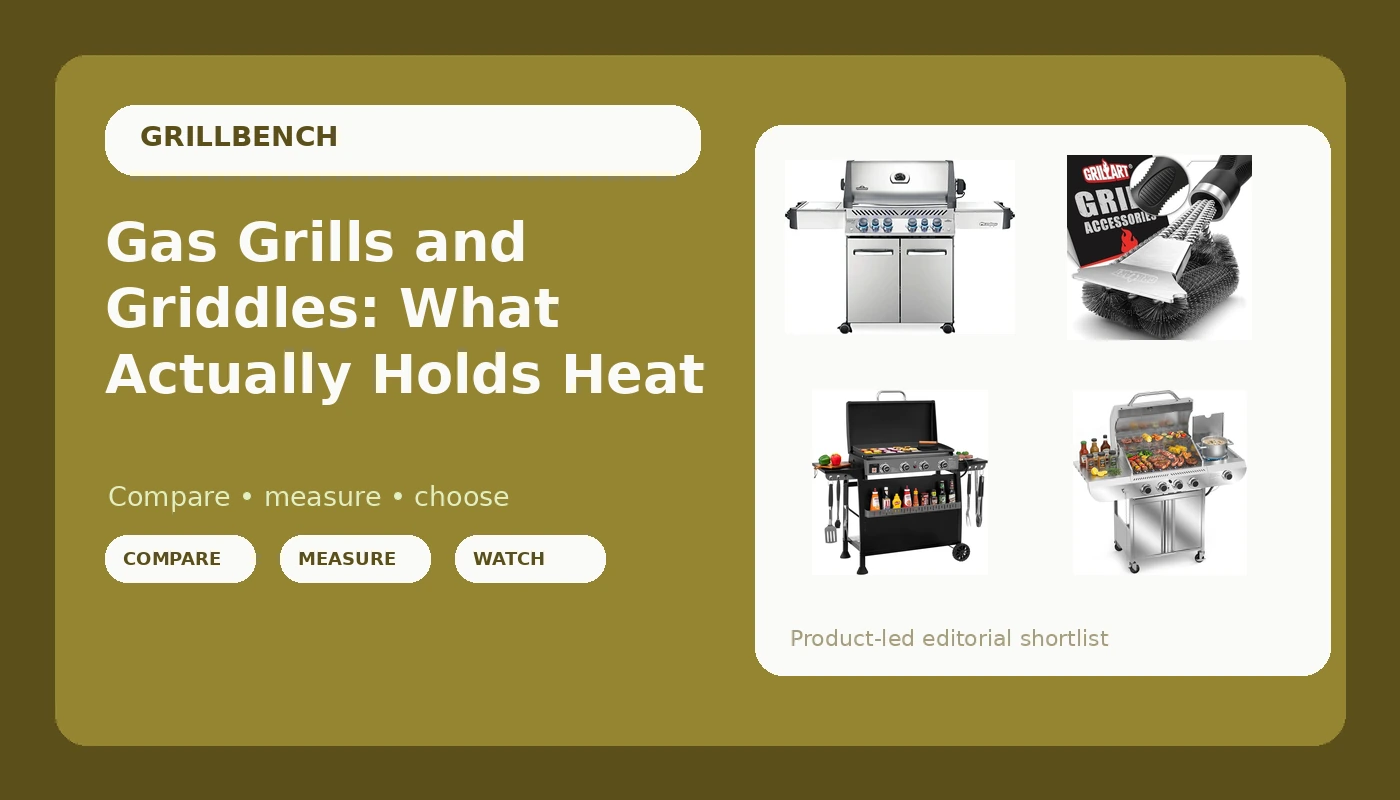
Best Overall: Napoleon Prestige 500 RSIB
The Napoleon P500RSIBNSS-3 Prestige 500 RSIB is the grill I recommend when somebody says they want to stop guessing. It runs on natural gas, which means no tank swaps, no running out mid brisket, no hose wrestling on a Sunday. If you have a gas stub at the house, that convenience is worth more than any feature on this list.
The part that matters is the infrared side and rear burner. Infrared is a different animal than a standard gas burner. It gets brutally hot, it gets there fast, and it puts the crust on a steak instead of steaming it. Most grills in this range advertise a sear zone that turns out to be a slightly warmer corner of the same grate. This one is a real sear station. The rear infrared burner is the rotisserie engine, and it earns its place if you spin chickens or a leg of lamb.
Build is stainless, and the cart feels like it was welded by somebody who expected it to be moved more than once. Burner layout runs front to back, which I prefer for two zone cooking because the hot side stays hot and the cool side stays genuinely cool. Side tables are usable, not decorative. And that is a low bar that a shocking number of grills fail.
Natural gas is the tradeoff. If your house does not have a hookup, this is not the grill for you, and running a line costs real money. Propane people should look at the Electactic below and put the savings into meat.
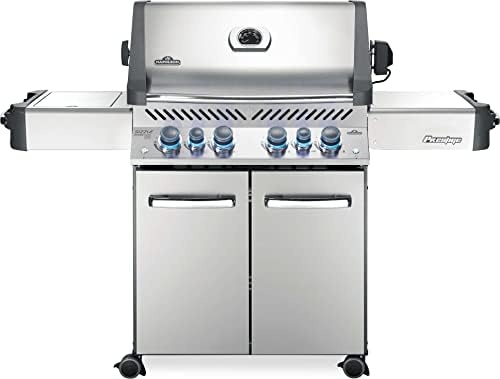
Best Flat-Top: Royal Gourmet PD4001
A griddle is not a grill, and the sooner you accept that, the better your cooking gets. The Royal Gourmet PD4001 is a four burner propane gas griddle on a removable standing cart, and it covers the entire category of food that falls through a grate: smash burgers with lace edges, breakfast for a crowd, fried rice, cheesesteaks, fajita vegetables, bacon without a grease fire.
Four burners across a flat top means you can run zones. Hot end for the sear, middle for the finish, low end for holding. That is the same logic as a line cook's flat top, and it is the reason a griddle cooks faster than most people expect. You are not fighting flare-ups because there is nowhere for the fat to fall and ignite. It hits the surface, it gets scraped to the trough, and it is gone. That single fact is why I reach for a flat top when I am feeding a crowd and want to talk to people instead of watching the lid.
The removable cart matters more than it sounds. You can run it on a counter or a patio table, or bolt it to the stand and roll it. Propane fuel means it works anywhere, which is the opposite of the Napoleon's natural gas luxury. Between the two, you have both worlds covered.
What it is not: a steak machine for thick cuts. You can do it, and the crust will be good, but a ribeye wants radiant heat and a lid. Buy the griddle for what a griddle does.
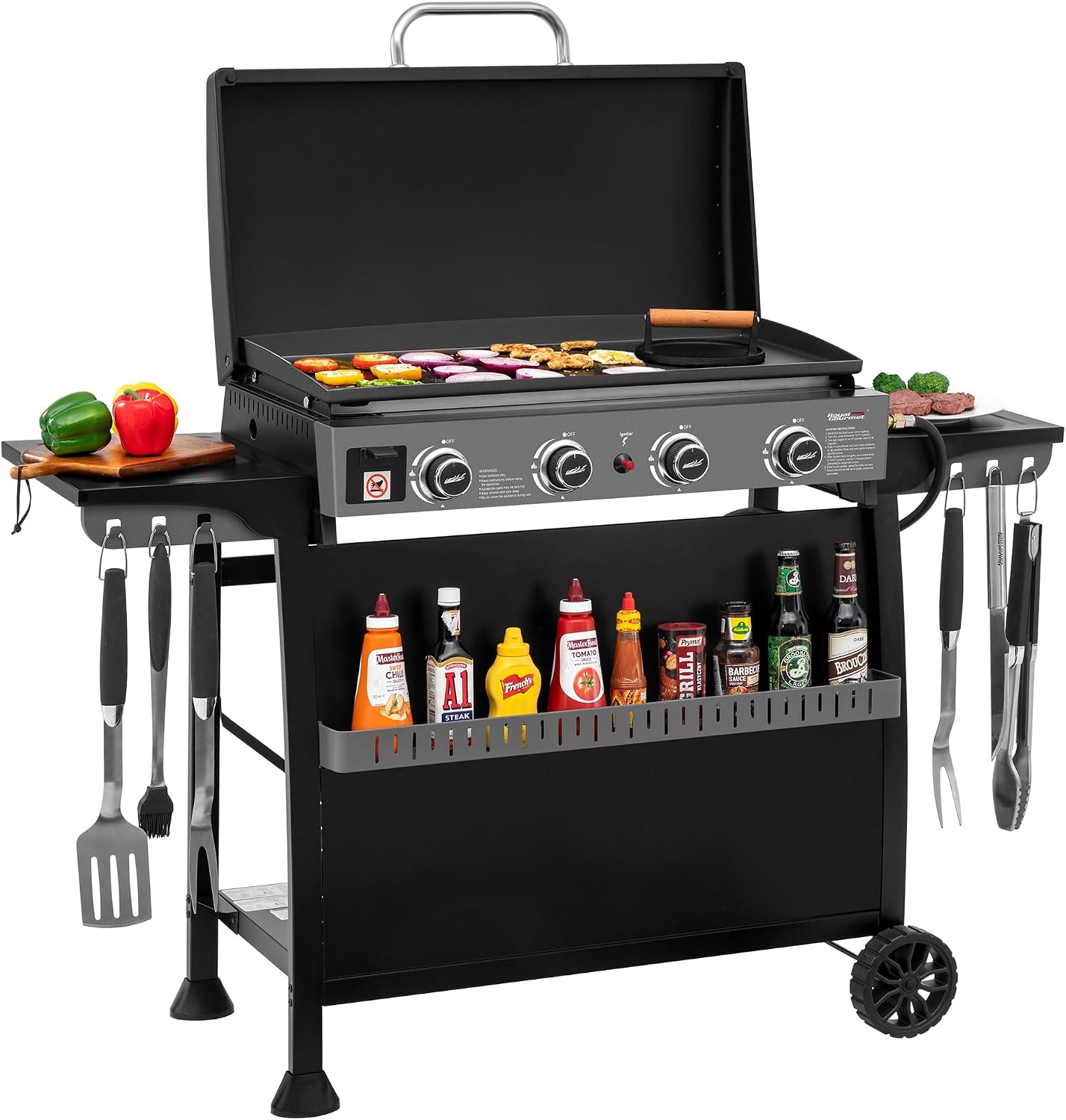
Best Budget Propane Grill: Electactic 4-Burner
The Electactic Stainless Steel 4-Burner Gas Grill with Side Burner is the entry point, and it is an honest one. Four main burners, 42,000 BTU, a side burner, a thermometer in the lid, stainless body. For a first propane grill on a patio or in a backyard, that is the correct feature list in the correct order.
The side burner is the underrated piece. It is where you boil corn, finish a sauce, or run a cast iron skillet for onions while the main grate works. Grills that skip the side burner save a few dollars and cost you a burner's worth of timing on every cook. The lid thermometer is a rough instrument, not a probe, but it tells you when you are in the neighborhood of 350, which is more than a lot of budget grills bother to tell you.
Four burners also means you can run two zone cooking without trying. Light the left two, leave the right two off, and you have a sear side and a rest side. That is the single most useful technique in gas grilling and it costs nothing.
The caveat is the same caveat that applies to every grill at this price. Stainless in this class is a coating story, not a marine-grade story. Keep it covered. Keep it dry. And when the igniter starts getting fussy, fix it before it strands you with a full grate of raw chicken. An igniter is the cheapest part on the grill and the fastest way to hate a machine you otherwise like.
The Accessory That Matters: GRILLART Grill Brush
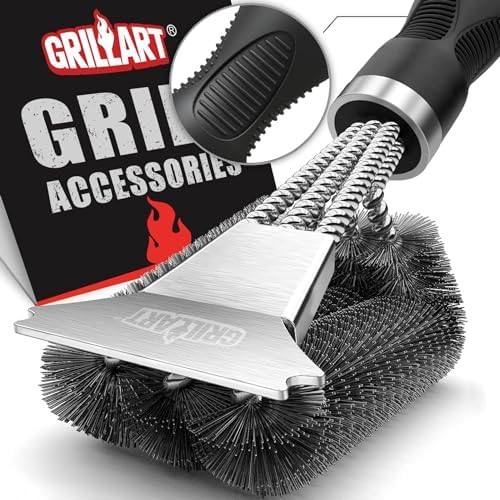
Nobody wants to read a brush section. Read it anyway, because a grill dies faster from neglect than from bad parts. The GRILLART Grill Brush runs an 18 inch handle with a scraper on the head, and the length is the whole point. You are cleaning a grate that is still hot. A short handle means your knuckles are three inches from 400 degree steel, and that is how people stop cleaning their grates.
The scraper does the heavy work on the crusted stuff, the bristles handle the rest, and the long handle lets you lean into it without a glove and a prayer. Do it while the grate is warm, before the residue bakes into carbon, and your grates last years longer. On the Napoleon and the Electactic, that is the difference between a grill that looks used and a grill that looks abandoned.
How I test a gas grill
Every grill gets the same three cooks, and I do not write about one until all three are done. A dozen burgers spaced across the grate, and I watch which ones finish first. That is the hot spot map, and it takes one cook to find. A full brisket or pork butt, which is a heat stability test, not a recipe. Can the grill hold a steady temperature for hours without me standing over it adjusting knobs? A chicken, skin on, over a lit burner, which is the flare-up test. If the fat drips and the fire climbs, I want to know on a chicken and not on a $60 rib roast.
I keep a spiral notebook for every cook. Ambient temperature, wind direction, where the hot spots were, how long the lid was open. The notes are boring and they are the only reason I can tell you anything useful. Recovery time is the number I care about most, and it is the number no spec sheet prints. It is how fast the temperature climbs back after you open the lid. A grill with fast recovery forgives you for checking. A grill with slow recovery punishes you for it, and you end up with a pale steak and a bad mood.
What the testing actually tells you
Burner layout predicts hot spots. Front to back burners, like the Napoleon uses, give you a clean vertical hot zone. Left to right burners give you a horizontal one. Neither is wrong, but you have to cook to the one you own, and the burger test tells you which one you got.
Flat tops are a different discipline. On the Royal Gourmet, the heat story is about surface area and scraping, not about radiant heat bouncing off a lid. The zone logic is the same, hot end and cool end, and the flare-up problem mostly disappears because the fat has nowhere to pool and burn.
Budget grills live and die on the small stuff. Side tables that fit a plate. A lid that seals well enough to hold heat. An igniter that fires on the first push in March and still fires in October. I have sent grills back over an igniter. I have never sent one back over BTU.
And cleaning is not optional. A dirty grate seasons like a dirty pan, which is to say it tastes like last week. Brush it warm, every time, and all three of these machines will outlast your interest in the next shiny thing.
Gas grill and griddle reference table
| Product | Fuel | What it is for | What to know | Price |
|---|---|---|---|---|
 Visit on Amazon → Napoleon Prestige 500 RSIB |
Natural gas | Steaks, roasts, rotisserie, two zone cooking | Real infrared sear zone, side and rear. Needs a gas hookup | $1,879.00 |
 Visit on Amazon → Royal Gourmet PD4001 griddle |
Propane | Smash burgers, breakfast, fried rice, bacon | Four burner flat top zones, removable cart, almost no flare-ups | $239.00 |
 Visit on Amazon → Electactic 4-Burner |
Propane | First grill, weeknight cooking, patio and backyard | Side burner, lid thermometer, 42,000 BTU, cover it and watch the igniter | $289.97 |
 Visit on Amazon → GRILLART Grill Brush |
Not fuel | Cleaning grates while they are still warm | 18 inch handle keeps hands off hot steel, scraper for the crust | $22.47 |
Should you buy the Napoleon Prestige 500?
Yes, if you have a natural gas line and you cook steaks with intent. The infrared side and rear burner is the reason to pay for this grill over a comparable stainless unit, and it is the feature most competitors only pretend to offer. Front to back burners give you a clean two zone setup, the cart is built for a decade of weather, and the fuel source removes an entire category of annoyance from your life.
It is not the grill for a renter with no gas hookup, and it is not the grill for somebody whose cooking is mostly hot dogs and griddle food. If that is you, buy the Royal Gourmet and a tank.
Should you buy the Royal Gourmet PD4001?
Yes, if your menu leans flat top. Four burners of surface with real zones, a removable standing cart, and propane fuel that works anywhere you can roll it. Smash burgers, breakfast for eight, fried rice, fajitas, bacon that does not turn into a grease fire. It handles all of it without the flare-up drama a grate creates.
Pair it with the Napoleon and you have both halves of a serious outdoor kitchen for less than the cost of one built-in unit. Pair it with the Electactic and you have a first setup that covers every cooking style a family actually uses.
Should you buy the Electactic 4-burner?
Yes, if this is your first propane grill. Four burners, a side burner, a lid thermometer, and 42,000 BTU is the right feature list at the entry price, and the two zone technique works the same on this grill as it does on the expensive one. Buy it, cover it, brush it, and learn your hot spots with a dozen burgers.
Should you buy the GRILLART brush?
Yes. It is the cheapest thing on this page and the one that decides whether the other three last. Eighteen inches of handle, a scraper on the head, and a cleaning habit that takes ninety seconds while the grate is warm. Buy it with the grill, not after the grates have already gone gray.