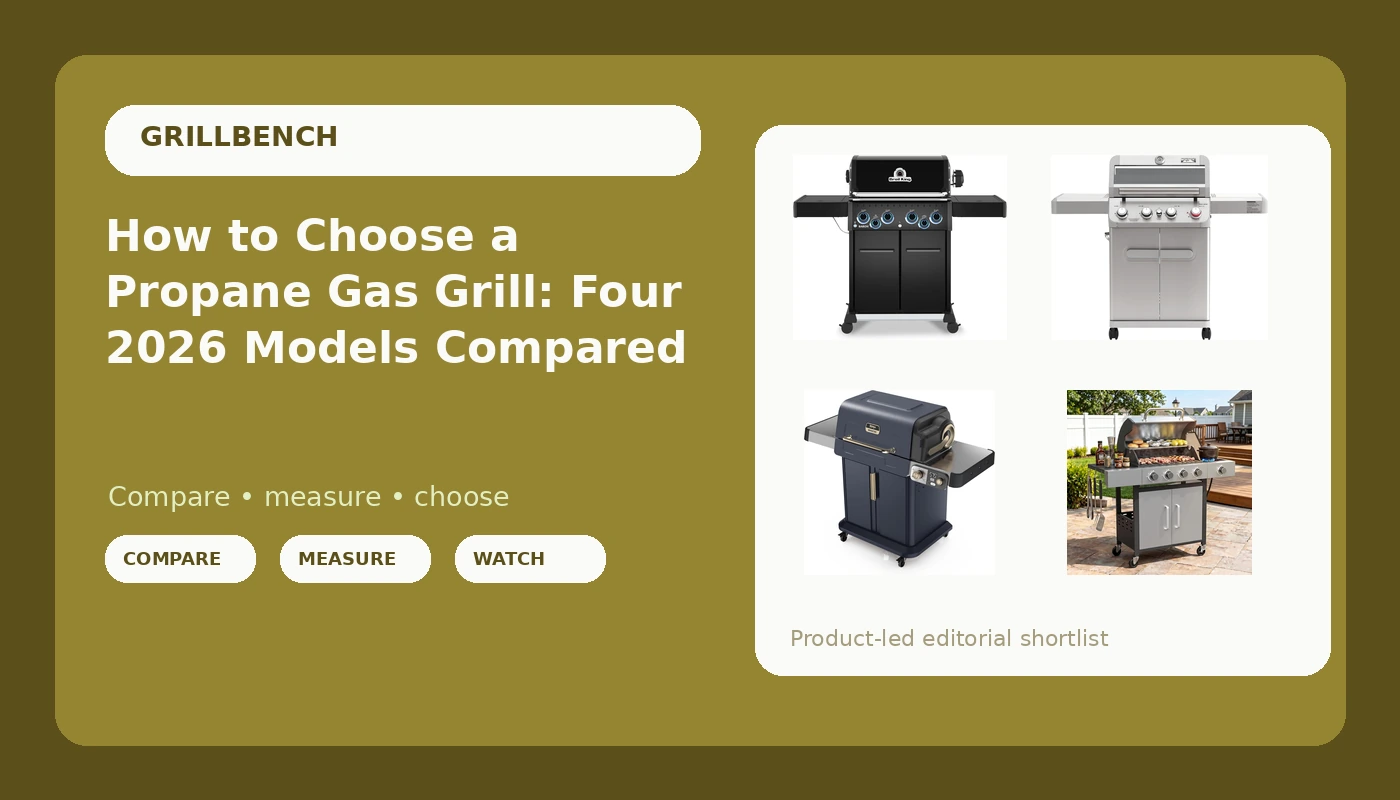
Buying a propane gas grill is mostly a decision about heat management, not about the number printed on the lid. The four models in this guide sit in different price bands and take different routes to the same goal: getting a wide cooking surface hot, holding that heat while the lid is open, and recovering quickly once it closes. A propane gas grill that does all three is a tool you keep for a decade. One that does none of them is a cart with a lid, and the listing copy will not tell you which one you are looking at.
The problem for a buyer is that the language is nearly identical across every listing. Four burners, stainless steel, even heating, easy cleanup. None of those phrases is a lie, and none of them is a specification you can compare. What you can compare is burner layout, the shape and material of the firebox and lid, the terms of the warranty, and whether the accessories bolted to the cart match the way you actually cook. Everything below is organized around those four things, because they are the parts of a propane gas grill that decide how it feels on a Tuesday night in July.
Related: Flare-Up Control on a Gas Grill: What Actually Helps →
Quick answer
Match the grill to the cooking you do most weeks, then verify three details on the listing: burner layout, warranty terms, and whether the firebox and lid are built to hold heat. A four-burner propane grill with independently controlled burners offers the most flexibility for the money. A unit that runs on electricity or propane is more forgiving on a small patio or a balcony where a full-size cart is a poor fit. A rear rotisserie burner and a side burner are worth paying for only if you will use them. BTU output is a starting point, not a ranking, and a higher number does not automatically mean a hotter cooking grate.
Four useful options
| Model | Best fit | What stands out |
|---|---|---|
| Broil King 674144 Baron 490 Pro Shadow 4-Burner Pellet Ready Propane Gas Grill | Cooks who want rotisserie capability and a side burner on one cart | Four main burners plus a side burner and a rear rotisserie burner, with a firebox listed as pellet ready |
| Ninja FlexFlame Grill & Smoker | Small patios, balconies, and anyone who wants the option to plug in or run propane | Runs on electricity or propane in a 5-in-1 cooking format |
| Monument Grills 4 Burner Propane Gas Grill, M410MBZ | Buyers who want a stainless four-burner cart with simple knob controls | Stainless steel construction, a broil zone the manufacturer describes as fast heating, and a design listed for easy cleanup |
| Aoxun 4-Burner Propane Gas Grill with Side Burner | A first grill, a cabin grill, or a second grill for a tailgate setup | Four burners, a side burner, and a listed 49,000 BTU output |
The rotisserie and side burner pick: Broil King 674144 Baron 490 Pro Shadow 4-Burner Pellet Ready Propane Gas Grill
A rear rotisserie burner is the single most misunderstood feature on a gas grill. It is a small infrared-style burner mounted at the back of the firebox, and it exists so you can cook a whole chicken or a roast on a spit with the heat coming from behind rather than below. When it works, it produces the crispiest skin of anything you can do on a gas cart. When it does not, it is a third burner you paid for and never light. The honest question is not whether the feature is good. It is whether you will spin meat more than a couple of times a season.
The side burner has a similar test. It is genuinely useful for a pot of beans, a skillet of onions, or a sauce you do not want smoking up the kitchen. It is useless if your patio already has a table and you do your sides indoors. If both of those features pass the use test, this is the most flexible cart in the group, and the pellet ready firebox gives you a path to wood-fired flavor later without buying a second grill.
The dual fuel pick: Ninja FlexFlame Grill & Smoker
Electric and propane solve different problems, and a unit that does both is really a hedge. Electric means no tank to swap, no hose to check for leaks, and no open flame, which matters on a balcony with a landlord, an HOA, or a fire code that has opinions about propane. Propane means you can cook at a tailgate, in a park, or anywhere the nearest outlet is a hundred feet away. Owning both options in one cart means you are not locked into either decision.
The trade-off is that you are buying a machine that has to be good at two things instead of one. Multi-function grills live or die on how easy the mode changes are, so pay attention to what the manual says about switching between electric and propane operation and how much of the cooking surface each mode covers. For a small household that grills two or three times a week, the flexibility is worth more than raw grate area. For a family cooking eight burgers at a time, a dedicated four-burner cart still wins on capacity.
The stainless four-burner pick: Monument Grills 4 Burner Propane Gas Grill, M410MBZ
Stainless steel is a material claim, not a performance claim, and it is worth understanding why. Stainless resists rust and cleans up faster than painted steel, which matters in humid climates and coastal air. It does not automatically hold heat better. What holds heat is mass: the thickness of the firebox walls, the weight of the lid, and the thermal mass of the cooking grates. Two grills can both be stainless and behave completely differently because one has a heavier lid that traps heat and one has a thin shell that dumps it every time the wind picks up.
Knob controls are the other thing to notice here. Digital controllers with displays and probes look impressive on a showroom floor, and they are also the part that fails first. A simple knob does one job and does it for years. If you want a cart you can hand to a neighbor without explaining a menu system, simple controls are a feature, not a compromise.
The entry point pick: Aoxun 4-Burner Propane Gas Grill with Side Burner
At the entry point, the calculus changes. You are not paying for refinement, you are paying for a cooking surface and a frame, and the question becomes what got left out to hit the number. Usually it is the thickness of the metal, the quality of the igniter, and the fit of the cart hardware. None of those things stop a grill from cooking. They do determine whether it still feels solid in year three.
The practical advice for this tier is to plan on replacing one consumable part early. Igniters, thermometers, and regulators are the usual candidates, and they are cheap to swap. What you cannot upgrade later is the firebox, so read the warranty terms on the firebox and burners before you order, and be honest about whether you need four burners or could do everything on two. A four-burner cart at this price is a reasonable buy if you understand you are getting a cooking surface first and a piece of furniture second.
Prices and availability may change. Product images, names, and retailer links are matched to verified listings. No current price, rating, stock status, or measured result is stated here without current evidence.
What BTU ratings and burner layout actually predict
BTU is a fuel consumption rate. It tells you how much gas the burners can move in an hour, and that is all it tells you. It does not tell you the temperature of the grate, because grate temperature depends on burner shape, grate material, the distance between the burner and the grate, and how much heat escapes around the lid. A grill with a high BTU number and a thin, leaky firebox will lose to a lower-rated grill with a tight lid and heavy cast iron grates almost every time. This is why comparing two listings on BTU alone is a mistake.
Burner layout matters more than burner count. Four burners arranged front to back give you four zones you can run at different temperatures, which is how you cook a sear on one side and hold a finished steak on the other. Four burners arranged in some other geometry can leave you with a hot band down the middle and dead corners. When you look at a listing, find a photo of the firebox with the grates off if one exists, and count how many burners run the full depth of the cooking area. If the burners are short and clustered, expect uneven heat.
The other spec worth caring about is recovery time, which almost nobody publishes. Recovery is how long the grill takes to come back to temperature after you open the lid. It is a function of thermal mass and burner output working together. You cannot read it off a spec sheet, but you can infer it from the weight of the lid and the thickness of the firebox. A heavy lid and a deep firebox recover faster because there is more stored heat to lose before the temperature drops.
Finally, look at where the heat exits. Vents at the back of the lid create a flow that pulls hot air across the cooking surface. Vents at the ends create dead zones. This is a small design detail that separates a grill you can cook on without thinking from one you have to rotate food on constantly.
How to match a grill to the cooking you do
- Write down what you cooked outdoors in the last month, not what you plan to cook. Burgers and brats point to a simple four-burner cart. Whole birds and roasts point to a rotisserie burner. Long low cooks point to a smoker function.
- Count the people you usually feed, then add two. Grate area is the one specification you cannot work around later.
- Decide where the grill lives. A balcony or covered patio narrows the field to a unit that can run on electricity or a compact cart, and rules out anything that needs generous clearance for a propane tank.
- Check the warranty line by line. Coverage on burners and the firebox is what matters; cosmetic coverage and painted cart panels are not worth much.
- Read the manual for the ignition system before you buy. If the listing does not say how it lights, that is a signal in itself.
Practical guidance before you order
- Measure the space twice, including the clearance you need behind the lid when it is fully open and the room for a tank beside the cart.
- Budget for a cover, a good instant-read thermometer, and a spare tank or a refill plan. These cost less than the grill and change how often you use it.
- Confirm the assembly requirements. Some carts arrive mostly built, others are a two-hour project with a wrench and a second person.
- Check whether the side burner needs its own regulator or shares the main line, and whether the hose length reaches where you plan to park the tank.
- Look for a grease management system you can actually reach. A drip tray you have to disassemble the cart to empty will not get emptied.
- Plan for the first cook to be a throwaway. Learn the hot spots with cheap food before you put an expensive cut on the grate.
Which option should you choose?
Choose the Broil King 674144 Baron 490 Pro Shadow 4-Burner Pellet Ready Propane Gas Grill when you want rotisserie capability, a side burner, and a firebox that can take pellets later, and you will actually use those features. Choose the Ninja FlexFlame Grill & Smoker when your cooking space has restrictions on propane, or when you want to switch between electric convenience and propane portability without owning two machines. Choose the Monument Grills 4 Burner Propane Gas Grill when you want a stainless four-burner cart with straightforward knob controls and easy cleanup, and you would rather not manage a digital controller. Choose the Aoxun 4-Burner Propane Gas Grill with Side Burner when you want four burners and a side burner at the lowest entry point and you are comfortable replacing a consumable part or two down the road.
One caveat applies to all four: the listings here describe features and formats, not measured performance. Nothing in this guide is a substitute for reading the current product page, the manual, and the warranty document, and no grill should be judged on its BTU number or its badge alone.
The bottom line
The right propane gas grill is the one whose layout matches your cooking and whose weak points you can live with. If you want the most cooking options in one cart, the Broil King model with the side burner and rear rotisserie burner covers the most ground. If your space or your fuel rules are complicated, the dual fuel Ninja is the flexible answer. If you want a stainless four-burner cart with controls that will not confuse anyone, the Monument M410MBZ is the straightforward pick. If budget is the deciding factor, the Aoxun four-burner delivers the same basic footprint for less, with the understanding that entry-level carts ask for a little more maintenance patience. Pick the one that fits the cooking you already do, confirm the warranty terms, and spend the difference on a thermometer and a cover.