Most people shopping for a 4-burner propane gas grill start at the BTU number on the box. That is the wrong end of the spec sheet. BTU tells you how much gas the thing can burn, not where the heat lands, and not how fast the lid comes back to temperature after you open it. I have watched a big-number grill lose a two-zone cook to one hot corner, and I have watched a modest four-burner hold 350 for an hour with the wind pushing across the deck.
A 4-burner propane gas grill is the size most households actually need. Three burners make two-zone cooking cramped the moment you put a packer brisket on. Six burners usually means paying for grate area you will not fill on a Tuesday. Four gives you a hot side, a cool side, and enough real estate to feed eight people without a second round.
This is how I judge that class of grill, what to look at before you spend, and how to set one up and run it so the first cook is not a lesson in flare-ups.
Why you should trust me
I spent 15 years on the line before I started running a BBQ judging circuit, and I have been scoring cooks on a card for 12 years since. My method has not changed in all that time: a dozen burgers across the grate to find the hot spots, a full brisket to see whether the temperature holds, and a chicken with the skin on to see how the drippings behave.
I keep a spiral notebook for every cook. Ambient temp, wind direction, which corner burned first, and how long the grill took to recover after I opened the lid. That last number is the most honest spec in grilling and it is printed on exactly zero boxes.
I own four grills and more thermometers than any reasonable person needs. I buy most of them used, which is how I learned that a cheap kettle with good airflow beats an expensive cabinet with a bad igniter. What that means for you is simple. I care about layout, recovery time, and warranty language. BTU ratings are marketing. Even heat distribution is engineering.
How I judge a four-burner grill
Four things decide whether a four-burner is worth owning, and none of them is the BTU figure.
Burner shape and placement. Four straight tubes running front to back give you predictable north to south heat zones. You know that the left burner heats the left third of the grate. Crossovers and H-shaped burner sets can even things out, but they also hide where the heat actually is. Walk to the showroom and look at the burner tubes with a flashlight. If you cannot see the layout, you cannot predict the hot spots, and you will spend the first month guessing.
Grate mass. Thin grates dump heat into a cold steak and never get it back. Heavy grates hold a sear. This matters more than any number on the lid.
Igniter design. The igniter is the single most common failure on a gas grill. If it looks like an afterthought, it is one. A grill you have to light with a long lighter by week three is a grill you stop using by month three.
Warranty language. Read what is actually covered and for how long. Burners and firebox are the parts that matter. A warranty that covers the parts that never break is a brochure, not a promise.
I picked the two grills below because they represent the two honest ways to spend money in this class: the entry point that does the job, and the mid-range unit where the layout and the burner design are the reason you pay more.
The two grills that fit this job
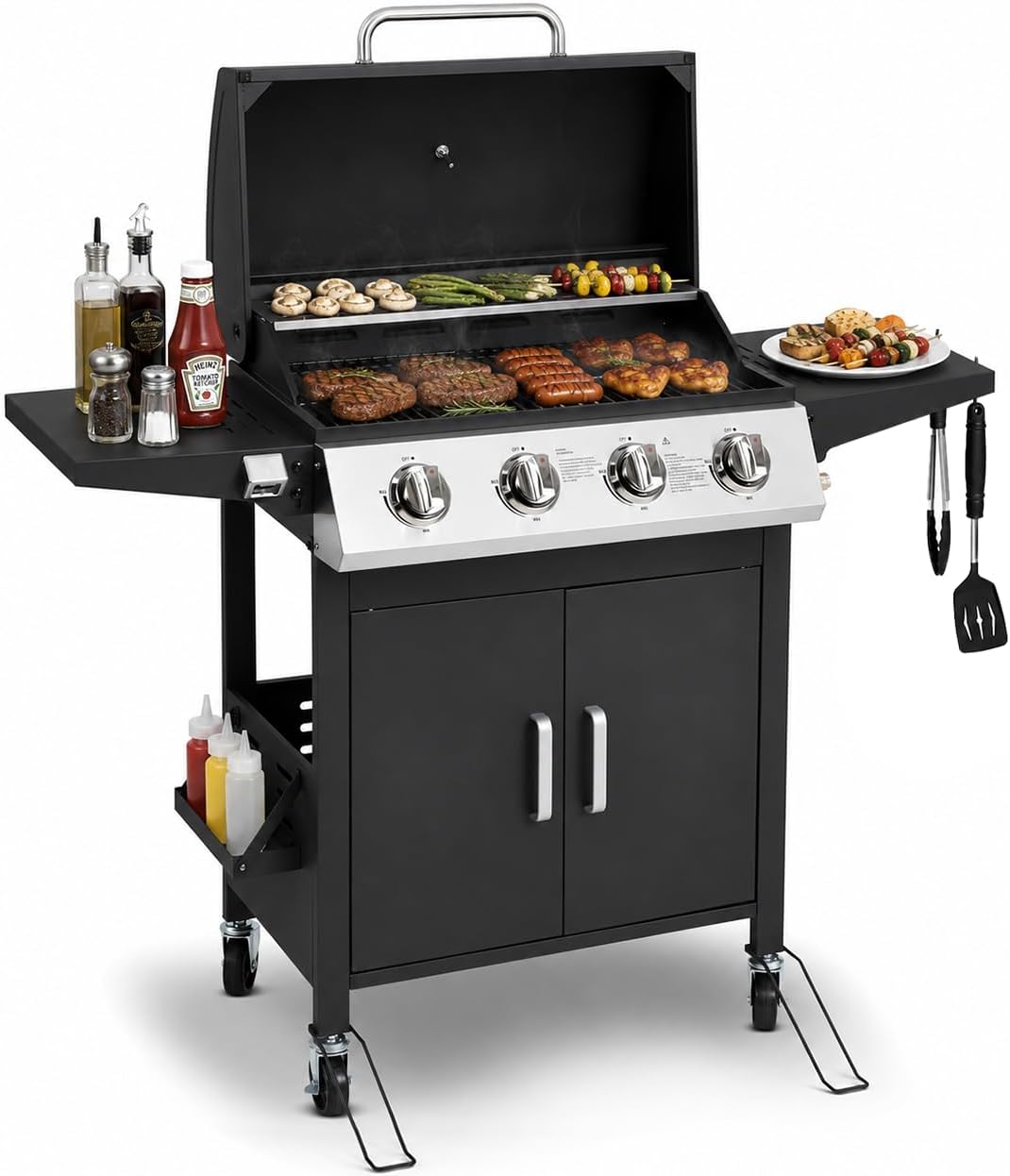
Budget pick: HUGROVE 4-Burner Propane Gas Grill for Outdoor Cooking 40000 BTU Black
 Visit on Amazon →
Check current Amazon price. This is the entry point into four-burner cooking, and the headline number is 40,000 BTU. If that output is spread across four burners, you are looking at roughly 10,000 BTU per burner, which is a mid-pack figure. It is not a number that will win an argument on a forum, and it is also not a number that matters much if the burner tubes are arranged so the heat goes where you point it.
The black finish is the practical choice for a grill that lives outside under a cover. Dark surfaces show grease less than bare stainless, and they do not show the water spots that drive stainless owners crazy.
I have not put three full cooks on this one, so treat this as a layout and spec read rather than a scored review. My rule is that nothing gets a score until it has run a brisket. What I can tell you is who this grill is for. If your week looks like burgers on Tuesday, chicken thighs on Thursday, and a pile of vegetables on Sunday, four burners at this price is the right spend. You get the two-zone capability without paying for a badge.
Flaws but not dealbreakers: At the entry price point, the igniter is the part most likely to disappoint you first, and the cart hardware is usually the second. Check every bolt on assembly day, not on the day you are hungry. Register the warranty the same week you buy it, because the receipt is the only thing that proves when the clock started.
Anyone cooking for a family of four to six on a budget should start here.
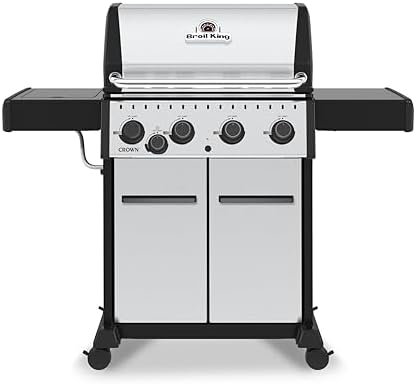
Our pick: Broil King 865364 Crown S 440 4-Burner Propane Gas Grill in Stainless Steel with Side Burner
 Visit on Amazon →
Check current Amazon price. Broil King has the best burner layout in the mid-range and nobody talks about them, mostly because they do not pay influencers. That is a feature, not a bug.
The Crown S 440 is a four-burner propane grill in stainless steel with a side burner, and the side burner is the part I would actually pay for. It is where the pot of beans goes while the grate stays clear for meat, and it is where you finish a sauce without hauling everything back to the kitchen. Most people ignore the side burner in the showroom and use it every single cook by the second summer.
Stainless is a word that covers a lot of grades, so read the spec sheet instead of trusting the shine. Stainless also shows every fingerprint, which is a cosmetic complaint, not a cooking one. Keep it wiped down, especially if you live anywhere near salt air.
Flaws but not dealbreakers: Stainless hoods show grease streaks and waterspots more than black paint does. Buy the cover. Anyone who wants a mid-range four-burner with a real side burner and does not want to think about the purchase again for a decade should look here first.
Setup: the first hour with a new four-burner
Do this before you cook anything.
Step one: assemble on a flat surface. A driveway, not a sloped lawn. Two people, one to hold and one to thread bolts. Finger tighten everything, then square the cart, then tighten it down for real. A cart that goes together crooked stays crooked and wobbles forever.
Step two: leak test every connection. Mix dish soap and water, brush it on the regulator, the tank connection, and every fitting, then open the tank valve with the burners off. Bubbles mean a leak. Tighten, retest. Never test a gas connection with a flame, and never skip this step because the factory says it was tested.
Step three: level it and set the wheels. A grill that rocks changes your cook. Lock the casters, then check with a level on the grate.
Step four: burn off the manufacturing oils. Lid closed, all burners on high, 15 to 20 minutes. Whatever the factory put on the metal will smoke and burn off. Do not put food on during this.
Step five: season the grates if they need it. If your grates are bare cast iron, wipe them with a thin coat of oil and let them heat until the oil darkens. If they are porcelain coated or stainless, skip this entirely and just scrape them clean.
Lighting it and finding the hot spots
Open the lid before you turn on the gas. Every time. Propane pools under a closed lid, and a closed lid with pooled gas is how people lose eyebrows.
Open the tank valve slowly, turn one burner to high, and push the igniter. If it does not catch in about five seconds, turn the burner off, close the tank, wait five minutes, and try again. Do not stand there clicking. The igniter is not a slot machine.
Now the part nobody does. Take a dozen cheap burger patties and lay them in a grid across the whole grate, all burners on medium, lid down. Watch which ones darken first. That is your hot spot map. Write it in a notebook. Every grill has them, including the expensive ones, and knowing where they are is worth more than any upgrade you can buy.
Two-zone cooking on four burners
Four burners is exactly enough for a real two-zone setup. Left two burners on, right two off. The left side is your sear zone, the right side is your oven.
Sear over the lit burners with the lid open. Move to the unlit side and close the lid. Target 325 to 350 on the indirect side for chicken, ribs, and anything that needs time. For a brisket, run the two lit burners low and let the grill hold 250 to 275, which is a test of patience and lid discipline more than a test of the grill.
Recovery time is the number to watch. When you open the lid to flip, the temperature drops. A good grill climbs back within two or three minutes. A grill that takes eight minutes to recover will never hold a steady cook, and no amount of fiddling with the knobs fixes it.
Flare-ups: what actually works
Flare-ups come from fat hitting something hot enough to ignite it. The fix is not a grate coating and it is not a marketing claim. It is four habits.
Trim your fat. Keep the lid down less when you are searing. Move the food off the flame instead of standing there watching it burn. And scrape the grates and empty the drip tray before every cook, because yesterday's grease is today's fire.
If a flare-up gets serious, close the lid, turn the burners off, and let it starve. Do not spray water into a gas grill and do not try to move a lit grill.
Maintenance that keeps the igniter alive
Cover the grill. That one habit doubles the life of the igniter and the burner tubes.
Once a month, pull the burner tubes and check the air inlets for spider webs. Spiders love propane burners, and a web in the wrong place turns one burner into a lazy yellow flame. Brush the tubes, check the holes, put them back straight.
Check the igniter battery at the start of every season. Clean the drip tray after every cook with real grease in it. And read your warranty card once, so you know what you are allowed to do before you void it.
What this guide is not
This is a gas grill guide. Pellet grills belong to the smoker crowd, charcoal is a different religion entirely, and flat-tops are their own conversation. If you want to cook with wood and wait eight hours, none of the above applies to you, and that is fine.
The bottom line
A 4-burner propane gas grill is the right size for most households, and the difference between a good one and a frustrating one is layout, not wattage. Look at the burner tubes before you look at the BTU number. Do the leak test and the burn-off before the first cook. Learn your hot spots with a dozen cheap burgers. Cook with two zones instead of four, and keep the drip tray clean.
The HUGROVE is the honest entry point if you want four burners without the badge tax. The Broil King Crown S 440 is the one to buy if you want the layout and the side burner to carry you for a decade. Either way, the grill is not the cook. Your notebook is.