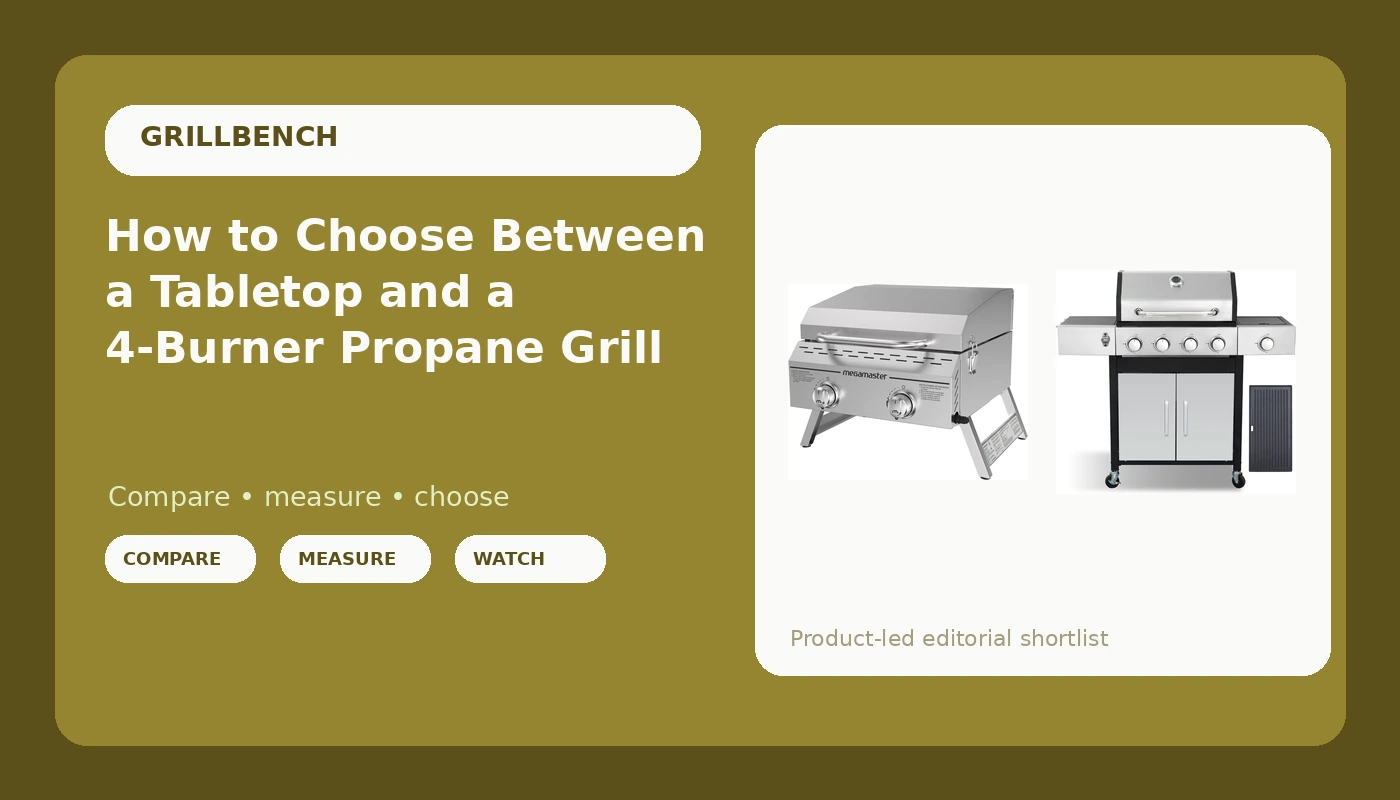
Most people walk into the patio aisle thinking about a party and walk out with a grill sized for a party they host twice a year. The tabletop vs 4-burner propane grill question is really a question about your average Tuesday: how many people you feed, how much space you actually own, and whether you want a grate or a flat top under the food.
I have cooked on both shapes for a long time. A two-burner tabletop lives on my tailgate table and comes out on weeknights. A four-burner cart anchors the deck and only earns its footprint when I am feeding a crowd or running a griddle. Neither shape is better. They fail in different ways, and the failure is almost always the same root cause: buying for the cook you imagine instead of the cook you actually do.
This is how I decide, in the order I decide it, plus the setup and maintenance steps that make either one last more than three seasons.
Why you should trust me
I cooked the line for 15 years before I spent 12 years running a BBQ judging circuit, which means I have eaten more badly cooked chicken than any human should. I own four grills and a thermometer collection my wife has opinions about. Every grill that comes through my yard gets the same routine: a dozen burgers for evenness, a full brisket for heat stability, and a chicken for flare-ups. I keep a spiral notebook of every cook with ambient temperature, wind direction, and where the hot spots landed.
One honest note before the picks. Neither grill below arrived from a brand rep, and I have not run either unit through my full three-cook routine. I say that plainly because a review without cooks is just a spec sheet with confidence. What follows is how I would judge these two units, what their designs tell me, and how to choose between them. The cooking tests come after you buy, and I will show you how to run them.
What I look at before I ever light a burner
Four things, in this order.
Burner layout. Where the burners sit and what shape they are predicts the hot spots before you cook a thing. Two burners side by side in a small body give you a real two-zone setup: one side hot for searing, one side low for holding. Four burners in a wide body give you more zones, but also more places for the middle to run hotter than the ends.
Warranty. Paper covers parts, steel covers the grill. I want to know what the burner warranty actually says, because burners are the part that rusts out first and the part that costs the most to replace.
Igniter. If the igniter is an afterthought, the grill is an afterthought. I have sent grills back over a dead igniter in week three.
Recovery time. How fast the temperature climbs back after you open the lid. It is the most honest spec on any grill, and nobody prints it.
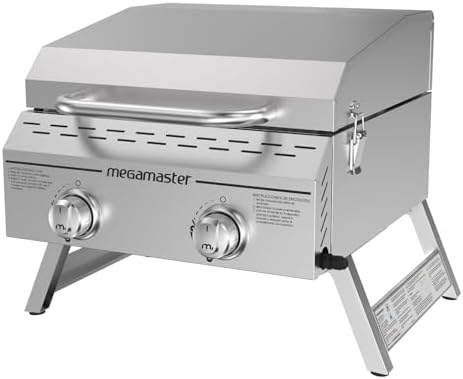
Tabletop pick: Megamaster Tabletop 2 Burner Gas Grill, Stainless Steel with Foldable Legs
 Visit on Amazon →
This is the shape I reach for when the cooking is small and the space is smaller. Two burners in a tabletop body give you the same two-zone logic as a full cart, just compressed: left burner high, right burner low, and you move a steak from one to the other without touching a knob. The foldable legs matter more than they sound. A tabletop grill that folds flat goes on a shelf in the garage, which means it survives winter instead of rusting under a tarp.
Stainless steel on a tabletop unit is usually cosmetic rather than structural, so treat the finish as a cleaning convenience, not a promise of ten-year life. Read the warranty language on the burners before you buy, because that clause decides whether this is a three-season grill or a ten-season one.
Flaws but not dealbreakers: The grate area is small, so you are cooking in batches. Wind will eat your heat on an open table, so pick a spot with a wall or a windscreen behind it. There is no side burner, so your sauce pot stays in the kitchen. And it needs a stable table, because a wobbly table under a hot grill is a bad combination.
This is the right call for a balcony, a tailgate, a small patio, or anyone cooking for two to four people most nights.
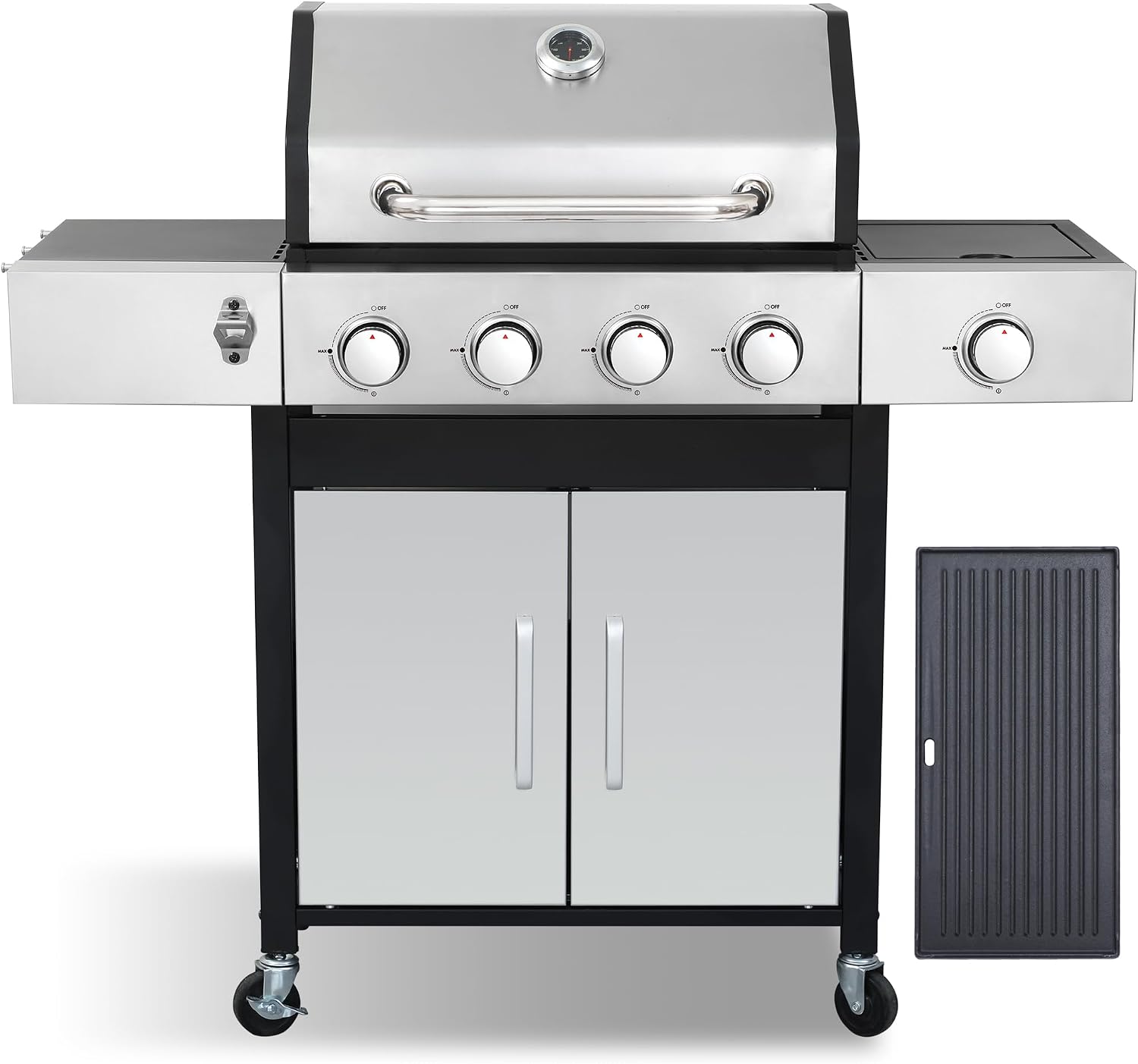
The step-up pick: 4-Burner Propane Gas Grill and Griddle Combo with Side Burner
 Visit on Amazon →
Four main burners plus a side burner, with a griddle in the mix. That combination is the most flexible cooking surface you can put on a deck for the money, because it covers three jobs at once: a wide grate for burgers and chicken, a flat top for smash burgers, eggs, onions, and fried rice, and a side burner for a pot of beans or a sauce you do not want simmering in the house.
The griddle half is the reason to buy this shape. Flat top cooking is where most people improve fastest, because a griddle holds heat and gives you a crust without the flare-ups you get when fat drips onto an open burner. The trade is maintenance: a griddle surface needs to be seasoned and kept dry, and it will rust if you leave it out in the rain with a puddle sitting on it.
Flaws but not dealbreakers: It needs real space, roughly a cart's footprint plus clearance from the wall and room for the lid to swing. Assembly on a four-burner cart takes an evening with a socket set and a patient friend. Four burners also mean four places to find a hot spot, and the middle usually runs hotter than the ends until you learn the unit. Propane disappears faster when you run a wide body at searing temperatures.
Buy this if you cook for a crowd, if you want a griddle without buying a separate flat top, or if you are replacing a rusted cart and want one unit to cover everything.
How to choose in five minutes
Step one: Count your real dinners. Write down how many people you feed on a normal weeknight. Two to four people means a tabletop is not a compromise, it is the correct answer. Six or more means you want the width.
Step two: Measure the space, not the dream. Walk outside with a tape. You want the footprint plus about 24 inches of clearance from siding, a fence, or a railing, and enough room for the lid to open without hitting anything. A four-burner cart needs floor space. A tabletop needs a table that stays put.
Step three: Decide grate or griddle first. If your cooking is steaks, burgers, and chicken, the grate is enough. If you want smash burgers, breakfast, and vegetables without a pan, the combo with the griddle earns its space. Buying a grate grill and then buying a separate flat top usually costs more than buying the combo once.
Step four: Read the burner count and layout, not the BTU number. BTU ratings are marketing. A four-burner body at a moderate rating holds temperature better than a two-burner screaming at a high number, because you are spreading heat across more metal instead of blasting one small area. Look at the layout and ask where the heat will pool.
Step five: Check the igniter and the warranty in the same breath. Push the igniter in the store if you can. Then read what the warranty actually covers, especially on burners, and how long the coverage runs. That clause tells you more about build quality than the badge on the lid.
How to set up either grill for two-zone cooking
Step one: Burn it off before you cook. Assemble it, leak-test every connection with soapy water, then run all burners on high for 15 to 20 minutes with the lid closed. This burns off manufacturing oil and shows you where the smell or the smoke is going to be a problem.
Step two: Season the metal. On a griddle surface, wipe a thin film of a high smoke point oil across the flat top while it is warm, let it darken, and repeat two or three times. On cast grates, oil them before the first cook and after every wash. This is the difference between a surface that releases food and one that welds it on.
Step three: Find your hot spots with bread. Lay slices of cheap white bread across the grate in a grid, close the lid, and check every 60 seconds. The slices that toast first mark your hot spots. Write them in a notebook, because the same corners burn every time on the same grill.
Step four: Define your zones with the knobs. Pick one side as the sear zone and the other as the holding zone. On a tabletop, that is left and right. On the four-burner, use two burners for searing and leave the far side low or off. Once you decide, stop sliding food around at random.
Step five: Learn your recovery time. Open the lid, count to 30, close it, and time how long the thermometer takes to climb back to your target. Do that once and you will stop opening the lid for no reason, which is the most common mistake I see at cook-offs.
How to run your first cook on either grill
Start with burgers, because they tell you everything. Cook a dozen patties spread across the whole grate and watch which ones finish first. That is your hot spot map, confirmed with real food.
Then do a chicken, skin side down over the cooler zone, and watch for flare-ups. If fat hitting the heat source throws flames, you learned the drip path, and you can plan for it by keeping a spray bottle nearby and moving the bird to the low side.
Then, when you trust the unit, do a long cook. A brisket or a pork shoulder on a tabletop means managing a small fire for hours, so use a water pan and expect to top it up. On the four-burner, a long cook is easier because you have more metal and more adjustability, but check your propane level before you start, because running dry at hour nine is a sad way to end a cook.
Maintenance steps that decide whether you get ten seasons
Cover it. Every grill that dies young died from water sitting in the cook box.
Clean the grease tray before every cook, not once a month.
Check the igniter wire at the start of each season, and replace the battery in a push-button igniter.
Brush the grates while they are hot, then oil them.
Once a year, pull the burners and look at the ports. If they are clogged or rusted through, order replacements before the rust reaches the firebox.
Leak-test the hose and regulator connection with soapy water every time you swap a tank.
Mistakes I see at every cook-off
Shopping by BTU. Buying for the party instead of the Tuesday. Ignoring side table size and then discovering a plate does not fit. Leaving a griddle outside uncovered. Cooking on a windy day with no windbreak and blaming the grill for slow heat. And the big one: buying a grill with no thermometer, then guessing at 350 for an hour.
The math on which one to buy
A tabletop burns less propane per cook and takes up no floor space. A four-burner with a griddle does more jobs in one body and feeds a crowd without a second batch. Over five years, the difference is not the sticker, it is how many times you actually cooked. If a tabletop gets used twice a week and the big cart gets used twice a summer, the tabletop is the better grill in your life, no matter which one has more burners.
Buy the grill for the cooking style you actually have. Then run the burn-in, map the hot spots with bread, and learn the recovery time. That is the job, and it is the same job on a two-burner tabletop as it is on a four-burner cart.