Most people buy a gas grill the way they buy a mattress. They lie down on the showroom model, decide it feels fine, and live with the mistake for ten years. The BTU number on the box did the selling. The burner layout you only notice after the first cook did the damage.
I spent 15 years on the line and a lot of weekends judging barbecue, and that taught me one thing a spec sheet never will: a grill is a heat management tool. A 6-burner propane gas grill and a folding portable are not the same purchase with different price tags. They answer two different questions. How many people am I feeding, and where am I standing when I feed them?
This is the version of that conversation I have with friends. Pick the machine for the cooking you actually do, set it up right in the first hour, then learn its hot spots with cheap food before you trust it with a brisket.
Why you should trust me
I cooked on the line for 15 years before I started running a barbecue judging circuit. Twelve years of judging teaches you to score a cook the way a competition does: flare control, recovery time, and whether the meat came off the fire tasting like the fire instead of the lighter fluid.
At home I own four grills and a thermometer collection my wife has opinions about. Every grill I write about gets the same treatment. A dozen burgers for evenness. A full brisket for heat stability. A chicken for flare-ups. I keep a spiral notebook with ambient temperature, wind direction, and where the hot spots showed up, because the notebook has never lied to me and the brochure always does.
The two grills below are here because they cover the two jobs most people actually have. One is a patio machine. One lives in a truck bed.
How I picked and how I tested
Every grill that gets a mention from me has to survive three cooks: the burger cook, the brisket cook, and the chicken cook. The burger cook tells you where the heat is. The brisket cook tells you whether the lid holds temperature for six hours without babysitting. The chicken cook tells you the truth about flare-ups, because chicken skin drips fat and a "flare-free" grate meets real fat eventually.
Here is what I look at, in order, before a grill earns a spot on this site.
Burner layout and shape. Six burners in a row is a wide heat zone, and wide means you can run two-zone cooking without stacking coals or guessing. Tube burners running front to back behave differently from burners running left to right, and the direction decides where your hot spot lands. I look at the drawing of the burner arrangement before I look at anything else.
Recovery time. How fast the temperature comes back after you open the lid is the most honest spec on the machine, and almost nobody prints it. A grill that can't hold 350 for an hour without you standing over it is a fire pit with a lid.
The igniter. If the igniter is an afterthought, the grill goes back. I will not light a $400 grill with a torch in week three.
The warranty. Paper covers parts. Steel covers the grill. A long burner warranty is worth more than any badge on the lid.
Would I trust it with a $40 brisket? That is the real test, and it is the one that separates a grill I recommend from a grill I tolerate.
The Royal Gourmet below is here because of its burner count and its side burner. The Charbroil is here because of its footprint. Those are the reasons they made the cut.
Two grills, two jobs
You can own one grill and be happy. You cannot own one grill that is good at both of these jobs, and anyone who tells you otherwise is selling something.
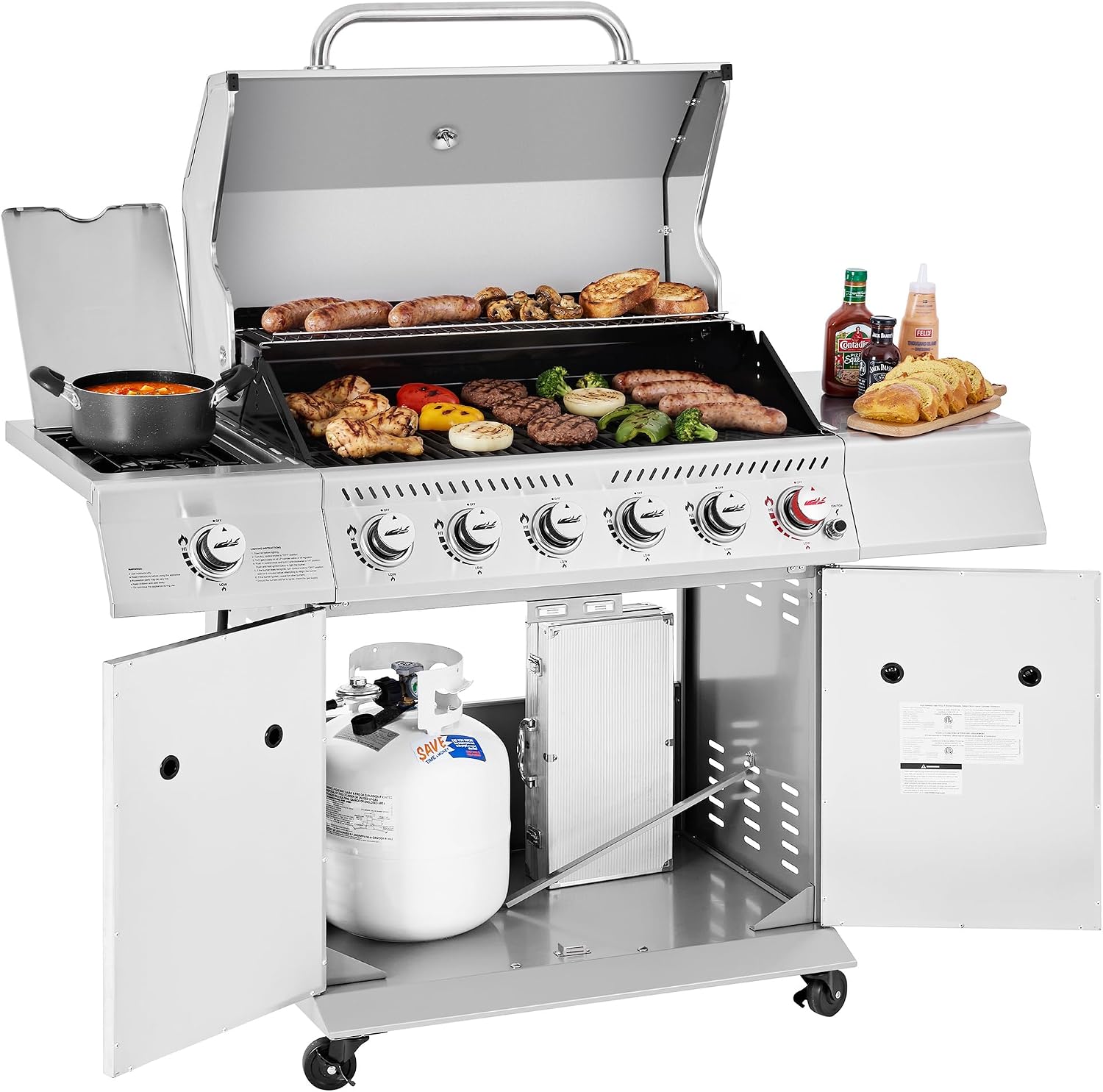
The patio workhorse: Royal Gourmet GA6402S 6-Burner Propane Gas Grill with Side Burner, Silver
 Visit on Amazon →
This is the configuration I point people toward when they host. Six main burners across a wide cook box plus a side burner gives you two things a smaller grill cannot: a long grate you can split into a hot side and a holding side, and a separate burner for a sauce pot, a skillet of onions, or a pan of beans while the mains run. Check current Amazon price.
The side burner is the part people underestimate. On a patio grill it is the difference between cooking one thing and cooking a meal. You sear on the mains, you finish a sauce next to them, and you are not running back into the kitchen with grease on your shoes.
Six burners also means six chances to learn a hot spot. The grates over the crossover area between burners will always run hotter than the grates at the far ends, and you will find that with the first dozen burgers, not with a steak you paid too much for. Do the burger cook first. Every time.
Propane is a utility, and a wide cook box is thirsty. If you cook for a crowd more than twice a month, keep a full spare tank. Running out mid-brisket is a rookie mistake that has nothing to do with the grill and everything to do with planning.
Flaws but not dealbreakers: A wide cook box is a lot of grate to manage for two people on a Tuesday. If most of your cooks are four burgers and a couple of chicken breasts, you are heating a lot of steel for no reason. Also, a grill this size wants a patio, not a balcony, and it wants a cover.
Anyone who regularly feeds eight or more, or who wants a side burner without buying a separate griddle, should look here first.
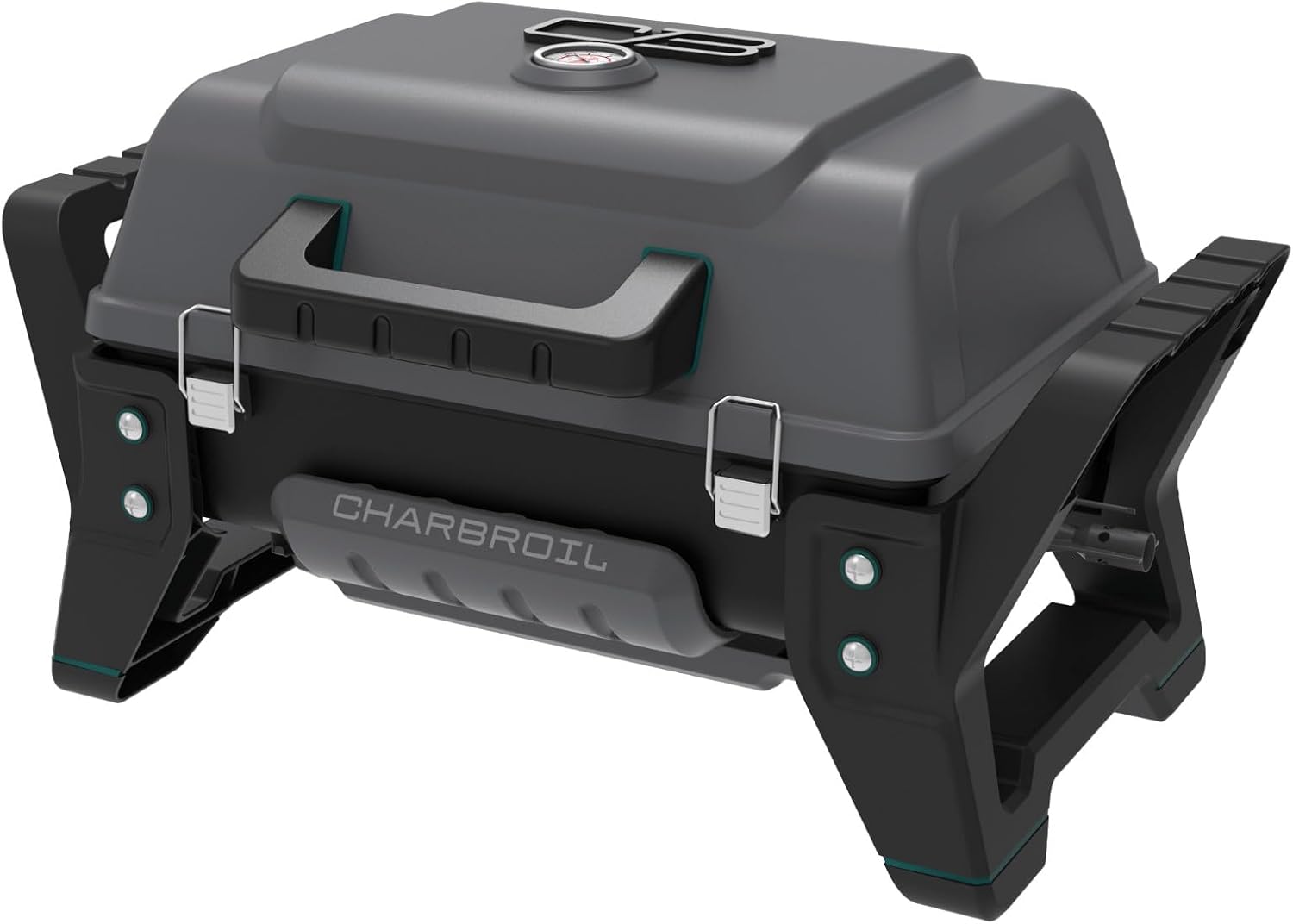
The tailgate pick: Charbroil Grill2Go X200 Portable Gas Grill, Dark Grey - 25409200
 Visit on Amazon →
The name on the lid tells you the job. This is a portable gas grill built to travel, and the whole point of it is that it fits in a truck bed, a trunk, or the back of an SUV next to a cooler without a second person helping you lift it. Check current Amazon price.
Where this class of grill wins is the cook you do most often. Four people, a package of brats, a few burgers, done in the time it takes the coals in a kettle to get gray. You set it on a tailgate or a picnic table, light it, and eat. No chimney, no ash, no waiting.
Where it loses is the same place every portable loses. The grate is small, so you cook in batches, and batches mean the first burger is cold before the last one is done. Small propane grills in this class typically run off a one-pound cylinder or a hose to a twenty-pound tank, and the listing is where you confirm which fittings come in the box. A one-pound cylinder is convenient and expensive per cook. A hose to a big tank is cheaper and less portable. Decide which one you are before you order.
Wind is the enemy of any tabletop grill. A portable with an open lid line and a low profile will lose heat in a parking lot breeze, so bring something to block it, even if that something is the truck.
Flaws but not dealbreakers: No side burner, obviously, and no room for a two-zone setup on a grate this size. You get one heat level and a corner that runs a little cooler, and that is the whole toolbox. Cook within it and it is a great little grill.
Anyone who tailgates, camps, or lives somewhere a full-size cart grill will not fit should start here.
Setting up a new gas grill: the first hour
Do these in order. Skipping step one is how people end up on the news.
Step one: leak test before the first light. Hook up the tank, open the valve, and brush soapy water on every connection: the regulator, the hose, the manifold. Bubbles mean a leak. Tighten, retest, and if it still bubbles, stop and call the manufacturer. This takes three minutes and it is not optional on a new grill.
Step two: understand the regulator and hose. Read the manual page that shows the hose routing. A hose that touches a hot firebox is a hose that fails. Route it where the manual says, not where it looks tidy.
Step three: burn off the manufacturing oil. Light the grill with the lid open, then close it and run it hot for 15 to 20 minutes. New grills have machine oil and packing residue on the internals, and you want that gone before food touches the grate. It will smell wrong. That is normal.
Step four: season the grates. Once the burn-off is done and the grill has cooled enough to handle, oil the grates with a high smoke point oil and run them hot again for ten minutes. Do this on a new grill and after every deep clean.
Step five: map the hot spots with bread. Cheap white bread is the best hot spot tool ever made. Lay slices across the whole grate, run the grill at medium, and watch. The slices that toast first show you exactly where the heat lives. On a six-burner, you will see the crossover areas go first. Write it in a notebook or take a photo.
Step six: your first cook should be burgers, not a brisket. A dozen burgers, spaced out, flipped once, and watched. You will learn the layout, the recovery time, and where to put the ones that need to move. Then you are ready to spend real money on meat.
What the box oversells
BTU numbers are marketing. A big number tells you how much fuel the burners can eat, not how evenly the grate heats, and those are two different engineering problems.
"Restaurant-grade" on a grill that costs less than a dinner service is a phrase, not a spec. Side tables smaller than a plate are a design failure, and you will feel it the first time you try to set down a sheet pan. And "flare-free" grates meet real chicken fat eventually, so plan for flare-ups by keeping a cool zone and a spray bottle instead of trusting a coating.
The grills that aren't in this article
Charcoal kettles, kamados, and pellet grills all cook great food, and none of them belong in a gas grill article. A pellet grill is a smoker with a controller, and if that is what you want, go read the smoker guides. A kettle is a religion and I respect it, but it is a different Sunday.
If you want one grill and you also tailgate, the honest answer is the portable plus a good cooler. A six-burner you cannot move is a patio grill, and pretending otherwise means you leave it at home.
What this all costs
The grill is the small part of the bill. Budget for a cover, a spare propane tank so you are never caught empty, a good instant-read thermometer, and a grill brush you replace when the bristles start shedding. Add a decent pair of gloves if you are moving hot grates around.
Divide the price by the number of cooks you will actually do in a year, not the number you imagine. That math is what makes the difference between a grill that was worth it and a grill that sits under a tarp. Check current Amazon price on both units and compare that number against how often you cook for a crowd.
The bottom line
Buy the grill for the cooking you do most weeks. A wide 6-burner propane gas grill with a side burner is the right tool if you host, and a portable is the right tool if you travel, and neither one is wrong. Set it up with a leak test, burn it off, map the hot spots with bread, and cook burgers before you cook anything expensive.
That is the whole job. The grill does the rest.