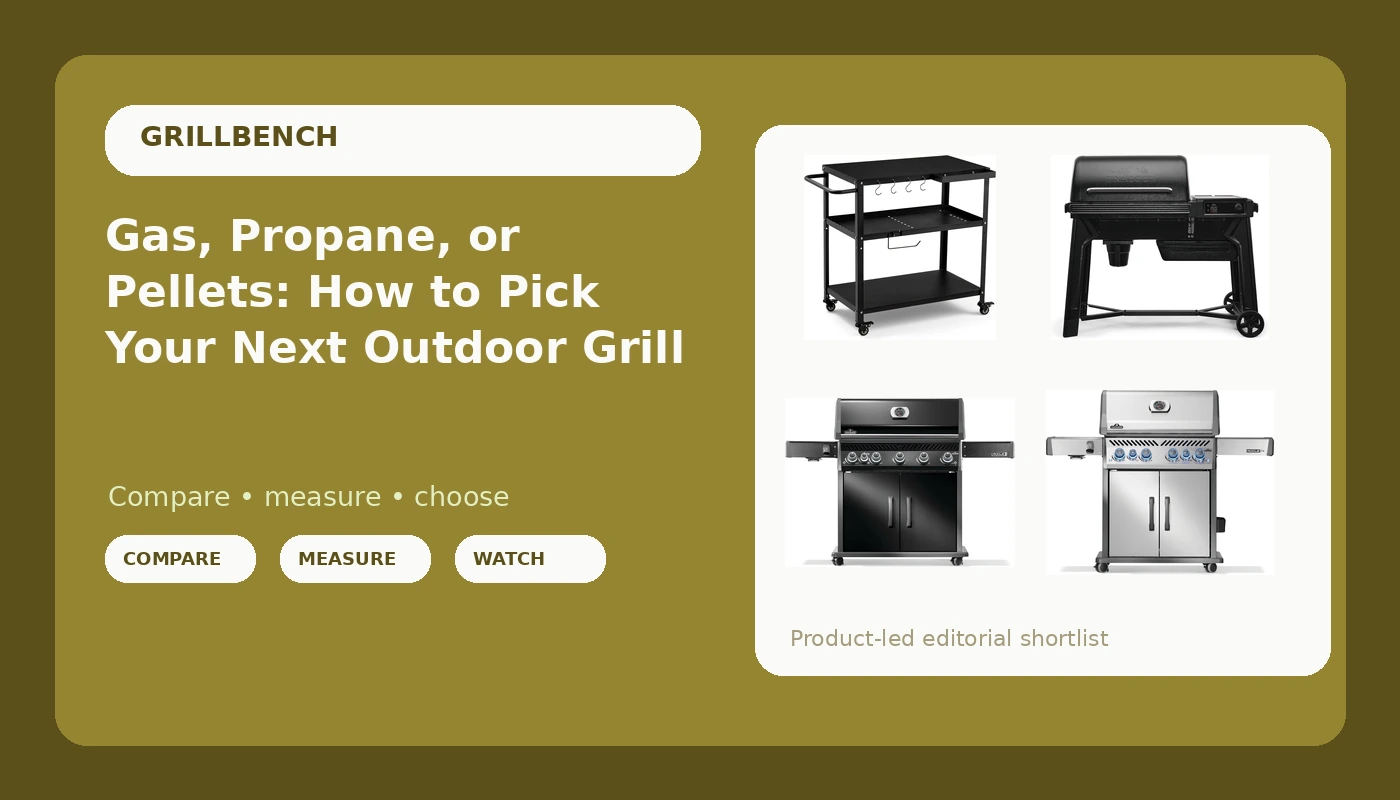
Buying an outdoor grill in 2026 comes down to something more basic than brand. What fuel will you actually run, how much grate do you need to feed the people who show up, and where is the thing going to stand while it does the work? That is the spine of this outdoor grill buying guide. Four listings sit behind it, and they are not four versions of the same product. One is a mobile cart and table that holds a cooker instead of being one. One burns wood pellets. Two burn gas, one plumbed to natural gas and one running on propane, with different burner counts and different burner jobs. Choosing between them is a question of plumbing, patio space, and what you cook on an ordinary Tuesday, not which badge looks shiniest under showroom lights.
Related: How Burner Layout Predicts Hot Spots Before You Cook →
Quick answer
Match the fuel to your house and your habits before you compare anything else. If there is a natural gas stub at the patio, a plumbed grill like the Napoleon Rogue PRO 625 takes tank refills out of your life entirely. If you rent, move the grill around, or want to keep your options open, propane is the portable answer, and the Napoleon Rogue PRO-S 525 is the four-burner version of that idea. If smoke flavor is the goal rather than a fast sear, a pellet cooker like the Traeger Woodridge is a genuinely different tool with a different rhythm. And if you are cooking on a tabletop unit, a pizza oven, or a griddle that lives on the ground, the Outdoor Grill Cart Table gives it wheels and a work surface. Check current Amazon price on any of them before you commit, because gas grill pricing swings hard with the season.
Four useful options
| Model | Best fit | What stands out |
|---|---|---|
| Outdoor Grill Cart Table, Pizza Oven Stand with Casters, Black | Anyone who needs a mobile base and prep surface for a cooker that has no legs of its own | A castered cart built as stand and table rather than as a cooking appliance |
| Traeger Woodridge Wood Pellet Grill & Smoker, 860 Sq In, WiFi | Cooks who want wood-fired smoke and remote temperature management | 860 square inches of cooking area and WiFi connectivity |
| Napoleon Rogue PRO 625 5-Burner Natural Gas Grill with Infrared Side Burner | A permanently plumbed patio setup with a large cooking surface | Five main burners plus an infrared side burner |
| Napoleon Rogue PRO-S 525 4-Burner Propane Grill - Rear & Side Burner | Propane users who want rear and side burner capability | Four main burners with both a rear burner and a side burner |
The support act: Outdoor Grill Cart Table, Pizza Oven Stand with Casters, Black
Let me be clear about what this one is not. There are no burners here, no ignition, no grate, no lid. It is furniture for cooking equipment, and the value depends entirely on whether you already own something that needs a stand. The trade-off is real: a cart like this does not add cooking capacity, it adds height, mobility, and a landing zone for tongs, trays, and a cold drink. If your patio is uneven, casters are the difference between a two-person lift and a one-hand push. If your cooker is a full-size gas grill with its own cart and side shelves, this is the wrong purchase. If your cooker is a tabletop pizza oven or a portable griddle currently sitting on a plastic table that flexes under heat, it is a sensible fix.
The smoke option: Traeger Woodridge Wood Pellet Grill & Smoker, 860 Sq In, WiFi
I do not run pellet reviews on this bench. That is the smoker crew's job, and I say so every time someone asks me to rank pellets against propane. What I can do is tell you where a pellet cooker belongs in your decision. It is a different cooking rhythm: pellets feed an auger, the controller holds a set temperature, and the flavor comes from the wood rather than from a sear on metal. That makes it excellent for long cooks and indifferent for a two-minute crust. The trade-offs are electricity, a fuel that stores differently from a propane tank, and more moving parts than a gas valve. If your weeknight cooking is burgers on a hot grate, this is not the machine. If your weekends are ribs, pork shoulder, and a brisket you want to watch from the couch, the 860 square inches and the WiFi connection are the reasons this listing exists.
The natural gas flagship: Napoleon Rogue PRO 625 5-Burner Natural Gas Grill with Infrared Side Burner
Natural gas is the luxury line in this lineup, and the trade-off is front-loaded. You need a stub at the patio, and if you do not have one, the cost of running a line is part of the purchase, not an afterthought. What you get back is the end of tank swaps, the end of the spare tank in the garage, and the end of the Sunday afternoon where the grill dies halfway through a chicken. Five burners give you zone control in a way four cannot: a hot end, a holding end, and a middle that behaves. The infrared side burner is a separate tool, not a gimmick, and it is where you finish a steak or run a pan without smoking out the main chamber. If you already have gas at the house and you cook for a crowd, this is the layout that makes sense.
The propane all-rounder: Napoleon Rogue PRO-S 525 4-Burner Propane Grill - Rear & Side Burner
Propane is a utility, and there is no shame in that. You own the fuel supply, you can take the grill to a tailgate or a rental house, and you never have to schedule a plumber. The rear burner is the detail people skip past. It is what makes a rotisserie bird work without fighting the main grate, and it is a second heat zone that a four-burner grill would otherwise not have. The honest trade-off against the five-burner natural gas unit is grate width and the fuel decision itself. Four burners cover most households comfortably. If you routinely cook for a dozen people at once, or you want the widest possible hot-to-hold spread, the extra burner matters. If you want a grill that follows you to the next address, this is the one that does.
Prices and availability may change. Product images, names, and retailer links are matched to verified listings. No current price, rating, stock status, or measured result is stated here without current evidence.
Fuel first: what actually decides the grill
The fuel question gets answered before the burner question, and it gets answered by your house rather than your preferences. Propane is a utility you buy by the tank and store yourself. Natural gas is a luxury that arrives through a pipe and never runs out mid-cook, provided you have the pipe. Pellets are a third category entirely: a solid fuel that needs electricity to feed and a controller to manage, which means a pellet cooker is a small appliance as much as it is a grill. None of these is better in the abstract. The wrong choice is the one that does not match how you actually cook.
That framing matters because the showroom experience hides it. Every grill on a sales floor is lit, warm, and surrounded by people who are not going to do your dishes. A plumbed natural gas grill looks identical to a propane one until you get it home and realize there is no stub within thirty feet of the patio. A pellet grill looks like a gas grill until the first time the power goes out during a long cook. Write down your fuel source, your outlet situation, and how far you are willing to carry a tank before you compare a single spec.
There is also a seasonal reality. Gas grills and pellet cookers are bought in spring and discounted in fall, which means the listing price you see in October is often not the price you will see in May. That is not a reason to wait if you need a grill now. It is a reason to check the current listing rather than trusting a number you remember from a review you read months ago.
Reading burner layout before you buy
Burner count is the headline, but layout is the story. Five burners in a row give you a wide temperature gradient across the grate: one end for searing, one end for holding, and a middle band that is genuinely useful for a whole chicken. Four burners do the same job in a narrower footprint, which is fine until you are cooking for a crowd and every zone is occupied. Neither number tells you where the hot spots will land. That is a function of burner tube spacing, grate material, and how the lid seals, and it is why I put a burger on the left and a burger on the right before I trust any grill with a forty dollar brisket.
Then there are the burners that are not in the main chamber. A rear burner is a rotisserie tool and a second heat source that runs behind the food. An infrared side burner is a searing station and a place to run a pan without opening the lid and dumping heat out of the main box. Both of these are the kind of feature that gets listed in small print and used constantly once you have them. If you rotisserie or you finish steaks hard, count them as part of the value. If you do neither, they are extra surface area to keep clean.
A practical order of decisions:
- Confirm your fuel source: gas stub, propane tanks, or a pellet supply and an outdoor outlet.
- Measure the patio and the clearance to the wall, fence, or railing behind the grill.
- Decide how many people you actually cook for on a normal night, not a holiday.
- Choose burner count from that number, then check whether rear or side burners earn their space.
- Sort out the stand, the prep surface, and the cover before the grill arrives, not after.
Setting up the patio around the grill
- Leave real clearance behind and beside the grill, since a lid that opens into a fence is a lid you will stop opening.
- Check the surface under the wheels. Casters roll on pavers and concrete, and they sink in gravel and soft turf.
- Plan the fuel logistics before the first cook: a filled spare tank, or a plumber's visit for a natural gas line.
- Buy a cover sized to the grill you chose, and use it, because a covered grill outlives an uncovered one by years.
- Keep a reliable thermometer on hand. The dome gauge is a decoration; the grate temperature is what you cook by.
Which option should you choose?
Choose the Outdoor Grill Cart Table, Pizza Oven Stand with Casters, Black when you already own a tabletop cooker, pizza oven, or griddle that needs a stable, mobile stand and a prep surface beside it. Choose the Traeger Woodridge Wood Pellet Grill & Smoker, 860 Sq In, WiFi when smoke flavor and long, monitored cooks are the point of your weekend, and you accept the different fuel and power requirements. Choose the Napoleon Rogue PRO 625 5-Burner Natural Gas Grill with Infrared Side Burner when you have a natural gas connection at the patio and want the widest cooking surface and the most zone control in this group. Choose the Napoleon Rogue PRO-S 525 4-Burner Propane Grill - Rear & Side Burner when you want gas grilling that travels, with a rear burner for rotisserie work and a side burner for pots.
One caveat worth stating plainly: everything above is about fit, layout, and fuel, drawn from the listings themselves. I have not measured these units on my own patio, and I am not going to pretend otherwise. Burner spacing, lid seal, and igniter quality are the things that decide whether a grill is pleasant or irritating, and those are the things you learn on cook one and cook three. Read the current listing, check the warranty terms in writing, and look at the return policy before you buy.
The bottom line
There is no single right grill in this group, because the four listings solve four different problems. The cart solves the stand and mobility problem for equipment that has no legs. The Traeger solves the smoke problem with a pellet feed, 860 square inches, and WiFi control. The Napoleon Rogue PRO 625 solves the volume and convenience problem for a house with natural gas already plumbed. The Napoleon Rogue PRO-S 525 solves the portability problem without giving up a rear burner. Start with fuel, move to burner layout, and only then compare the badges. Check current Amazon price on the one that matches your patio, and buy the grill for the cooking you actually do.