Related: How to Set Up Two Heat Zones on a Small Gas Grill
Portable propane grills are where the marketing gets loudest and the engineering gets thinnest. Every box promises "restaurant-grade" something, every listing shouts a BTU number, and almost none of them tell you where the hot spot will land on cook one. I spent 15 years on a line and another 12 judging barbecue, and this is the category I get the most questions about, usually from somebody with a balcony, a tailgate spot, or a campsite that does not allow charcoal.
Here is what I tell all of them: BTU ratings are marketing, even heat distribution is engineering. A 30,000 BTU portable and a 20,000 BTU portable can behave completely differently depending on how many burners split that output and where those burners sit under the grate. So before you buy anything small, count the burners, look at the grate material, and ask yourself what you actually cook on a Tuesday night.
Below are four small propane grills I would point people to right now, sorted by the job each one does best. One note up front: I have not put three full cooks on all four of these units, and my rule is no review without three cooks. Treat this as a buying guide built on the specs the manufacturers publish, the burner layouts, and a lot of years cooking on small propane grills. When I get a full cook on one, I will say so.
Best for a Full Cookout Setup: 3-Burner Propane Grill with Folding Side Tables
This one reads like a full-size grill that shrank. Three burners, cast iron grates, a stainless steel griddle pan, folding side tables, and wheels, at a stated 30,000 BTU. For a patio or a driveway, that combination covers more cooking styles than anything else in this group.
Three burners on a small body is the whole point. It means heat zones, which means you can sear on the right and hold on the left, or shut the middle burner off and use that side as an indirect box. That is how you cook a whole chicken or a rack of ribs on a small grill without turning dinner into charcoal. The griddle pan is the sleeper feature: smash burgers, bacon, eggs, peppers and onions, all the stuff that drops through a grate. Cast iron grates hold heat and give you a real sear, but they need a wipe of oil after every cook or they will rust on you by August.
Folding side tables are worth more than people think, and they are also the first place a manufacturer cuts cost. Check the size before you buy. If a side table cannot hold a sheet pan, it is decoration. The wheels make this a roll-it-out grill rather than a carry-it grill, so it is the wrong pick if the thing has to live in a trunk.
Best for Tailgates and Camp Kitchens: Coleman RoadTrip 285
The RoadTrip 285 is the one I see in parking lots. Stand-up portable, legs that collapse, three adjustable burners, and Instastart push-button ignition, at a stated 20,000 BTUs.
Three adjustable burners on a portable is a bigger deal than it sounds. Adjustable means you can dial each one independently, so you get a small version of the heat zone setup: one burner wide open for the sear, one at a whisper for the hold, one off. It is the difference between grilling and hoping.
The stated output is the honest part of the spec. Twenty thousand BTUs spread across three burners is a lower-output grill than 30,000 across three, and that shows up as recovery time. Recovery time is how fast the temp comes back after you open the lid, and it is the most honest spec in grilling. Keep the lid down, and plan on a minute of patience after you flip.
Instastart matters to me more than most features, because igniters that die in the first season are my number one pet peeve. A portable grill you have to light with a stick lighter is a portable grill you stop taking places. Push-button start on a stand-up body is what this category should have been doing all along.
Best for a Balcony or a Two-Person Patio: Megamaster Tabletop 1 Burner
Tabletop format, one burner, foldable legs, and a warming rack. This is the grill that lives on a picnic table, a tailgate, or a small balcony table, and it stores in a closet when the weather turns.
One burner means one zone, and I want you to go in knowing that. There is no sear on the right and hold on the left. Your only move for temperature control is distance: lid down for heat, warming rack for the food that is done and needs to stay warm while the rest catches up. That rack is not a gimmick on a single burner, it is your only holding area.
For two people doing burgers, dogs, a couple of steaks, or vegetables, this is plenty of grill. For four people who all want something different, it is a traffic jam. Foldable legs are the reason it works for apartment cooking, because the alternative is a grill that permanently owns a square of your balcony.
Best for the Tightest Space: Char-Broil Portable Convective 1-Burner
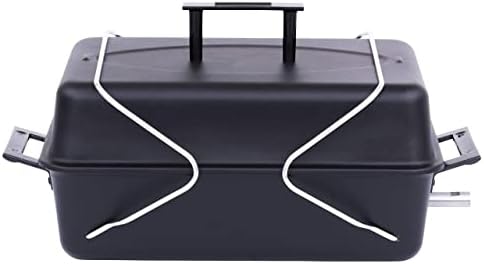
The Char-Broil Portable Convective is the smallest and simplest thing here, and it has been around long enough that you probably know somebody who owns one. The convective part is the lid design: it is shaped to move heat around the food rather than straight up past it. On a single burner that matters, because a single burner concentrates its heat in the middle of the grate.
That is the honest limitation of any one-burner grill. Expect the center of the grate to run hotter than the edges, which is a hot spot you manage by rotating food rather than by turning a knob. Once you know where it is, it is not a problem, it is just where you start the chicken thighs and where you finish them.
What this grill buys you is a small footprint, a simple body, and a low entry point into propane cooking for a balcony, a campsite, or a first apartment. It is not a brisket machine. It is a grill for a couple of burgers, a few dogs, and a piece of fish on a weeknight, and it does that job without asking for much room.
How I judge a portable gas grill
My checklist is the same one I use on a $1,400 rig, just scaled down.
Can I cook on it? No opinion without a cook, and no review without three. Where are the burners and what shape are they? Burner layout predicts hot spots better than any other spec, because heat follows geometry, not advertising. What does the warranty actually cover? Paper covers parts, steel covers the grill. And the last one: would I trust it with a $40 brisket? That is the real test, and it is why I care so much about how many burners a small grill has.
I also keep a spiral notebook of every cook: ambient temp, wind, where the hot spots were, how long the lid was open. Wind matters more on a portable than on a full-size grill, because there is less steel around the firebox to hold heat. A breezy balcony can cost you 50 degrees, and no spec sheet will tell you that.
Analysis: what the specs actually tell you
Burner count is the single biggest predictor of what a small grill can do. Two burners is the minimum for two-zone cooking. Three is comfortable, because you get a sear zone, a hold zone, and a spare you can run wide open when you need to come back from a long lid-open session. One burner is one zone, and your only temperature control is distance and time.
BTU per burner is the number worth doing the division on, and even then, treat it as a hint rather than a promise. A grill with a lot of stated output spread thin across three burners will sear differently than one with less output concentrated in a smaller body. Output tells you about recovery. Grate material tells you about sear and about how the thing ages.
Grate material is where the money hides. Cast iron holds heat and gives you a real crust, and it will rust if you ignore it. Thinner stamped grates heat fast and cool fast, which makes them better for delicate food and worse for a steak. Neither is wrong, but you should know which one you are buying before the box shows up.
Ignition is the feature that decides whether you use the grill. An igniter that dies in season one turns a five-minute weeknight cook into a scavenger hunt for a lighter. Push-button ignition in a portable is not a luxury, it is the whole reason the grill is convenient.
Side tables are the last thing on the spec sheet and the first thing you will curse. If a table cannot hold a plate, you will end up balancing a tray on the ground next to a hot grill, and you will do it exactly once before you get annoyed.
Flare-up control comes down to how far the burner sits below the grate and how the drippings drain. Fat hits hot metal, fat burns, and no grate coating on earth fixes bad geometry. The grills that behave have room between the fire and the food, and a drip path that gets the grease out of the way.
Portable propane grill comparison
Every one of these is a small propane grill, and every one of them is aimed at a different setup. Use the table as a starting point, then go read the listing for the one that matches your space.
| Grill | Burners | Stated output | What the listing says it has | Best for | Price |
|---|---|---|---|---|---|
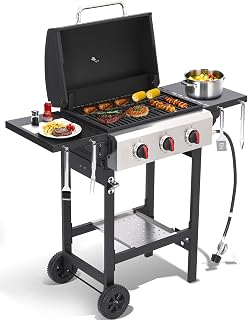 Visit on Amazon → Visit on Amazon →3-Burner Propane Grill with Folding Side Tables |
3 | 30,000 BTU | Cast iron grates, stainless steel griddle pan, folding side tables, wheels | Patio and driveway cooks with real heat zones | $143.99 |
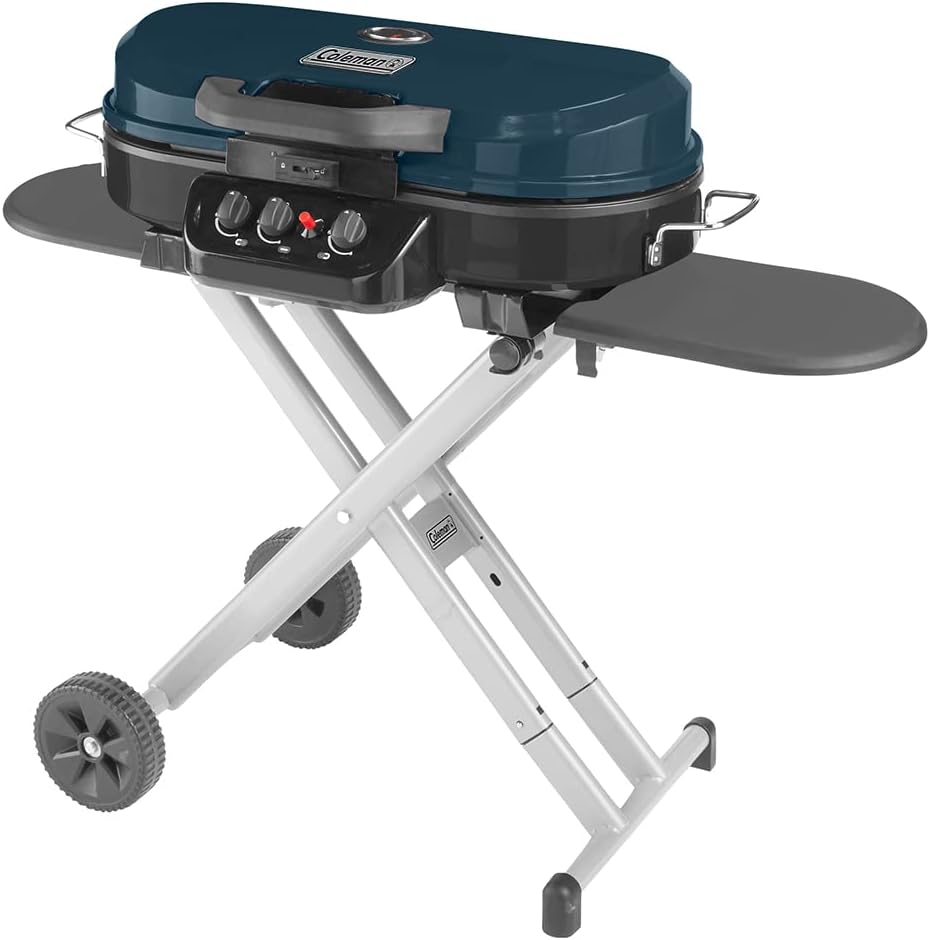 Visit on Amazon → Visit on Amazon →Coleman RoadTrip 285 |
3, adjustable | 20,000 BTU | Stand-up portable, collapsible legs, Instastart ignition | Tailgates, camping, cooking away from home | $289.99 |
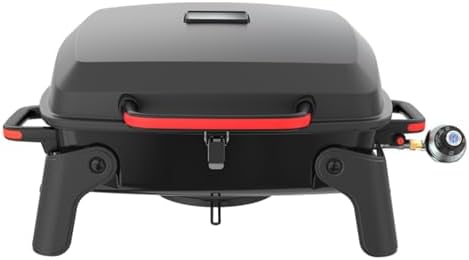 Visit on Amazon → Visit on Amazon →Megamaster Tabletop 1 Burner |
1 | Not stated | Foldable legs, warming rack | Balconies and two-person patios | $89.00 |
 Visit on Amazon → Visit on Amazon →Char-Broil Portable Convective |
1 | Not stated | Convective lid design, portable body | Smallest spaces, simplest cooks | $54.99 |
The one-burner reality check
If you are looking at either single burner grill, be honest about how you cook. Two people, simple food, weeknights: you will be happy. Four people, different preferences, a brisket on a Sunday: you will be fighting the grill instead of cooking on it. Buy the grill for the cooking style you actually have, not the one you imagine at the showroom.
The tabletop trap
Tabletop grills look like they save space, and they do, but they also put the cooking surface at table height. If the only table you own is the one you eat at, you are now grilling on the dining table, and the grease has an opinion about that. Measure the surface you plan to set it on before you buy, and make sure it is stable enough that a spatula push does not slide the whole grill.
Should you buy the 3-burner with folding side tables?
If you have a patio or a driveway and you want one small grill that covers the most ground, yes. Three burners plus a griddle pan is a heat zone setup and a flat top in one body, and the folding side tables and wheels make it a roll-out grill instead of a carry-it grill. Cast iron grates are a long-term commitment: oil them or lose them.
Check the side table size in the listing photos before you commit, because that is where small grills cut cost, and a table that cannot hold a plate is a table you will never use.
Should you buy the Coleman RoadTrip 285?
Yes, if you cook away from home. Three adjustable burners and push-button ignition in a stand-up portable with legs that collapse is exactly what a tailgate or a camp kitchen needs, and the adjustable burners give you a small version of two-zone cooking. The stated 20,000 BTUs across three burners means a lower top end and a slower recovery than a bigger grill, so keep the lid down and give it a minute after you open it.
If you are cooking for one or two on a balcony and you never leave the house with a grill, the tabletop single burner is the smarter buy. If your space is smaller still, the Char-Broil Convective is the simplest way in. Match the grill to the job, and you will use it a lot more than the one that sounded impressive in the store.