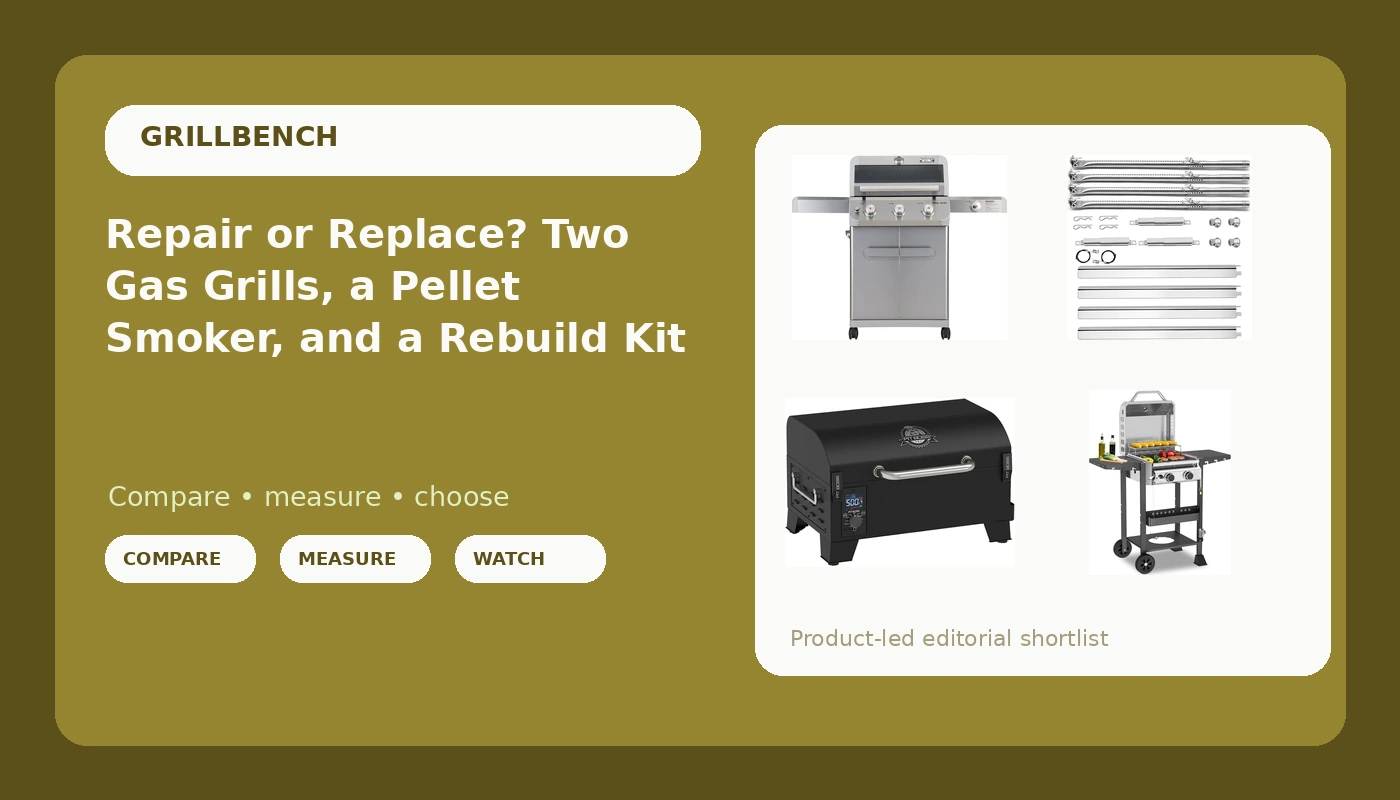
I spent 15 years on a restaurant line and 12 more judging barbecue competitions, and the thing that still gets me is how differently two grills with nearly identical spec sheets cook a burger. This propane grill comparison exists because the question I get asked most is not "which grill is best." It is "should I fix the one I already own, or buy a new one," and those are two very different answers depending on what you actually cook on a Tuesday.
So I lined up four buys that have no business sharing a table: a compact two-burner, a three-burner with a side burner, a pellet smoker, and the rebuild kit that keeps a tired four-burner alive. One of them is a grill. One of them is a small appliance pretending to be a grill. One is a smoker, and one is a box of parts. That mix is the point.
Related: How to Find the Hot Spots on Any Gas Grill
For most people, the Monument Grills Mesa 3+1 is the pick, because three main burners plus a side burner gives you actual heat zones instead of one hot strip you spend the whole cook fighting. The rest of this is the reasoning, including the two cases where the cheaper choice or the stranger choice is the right one.
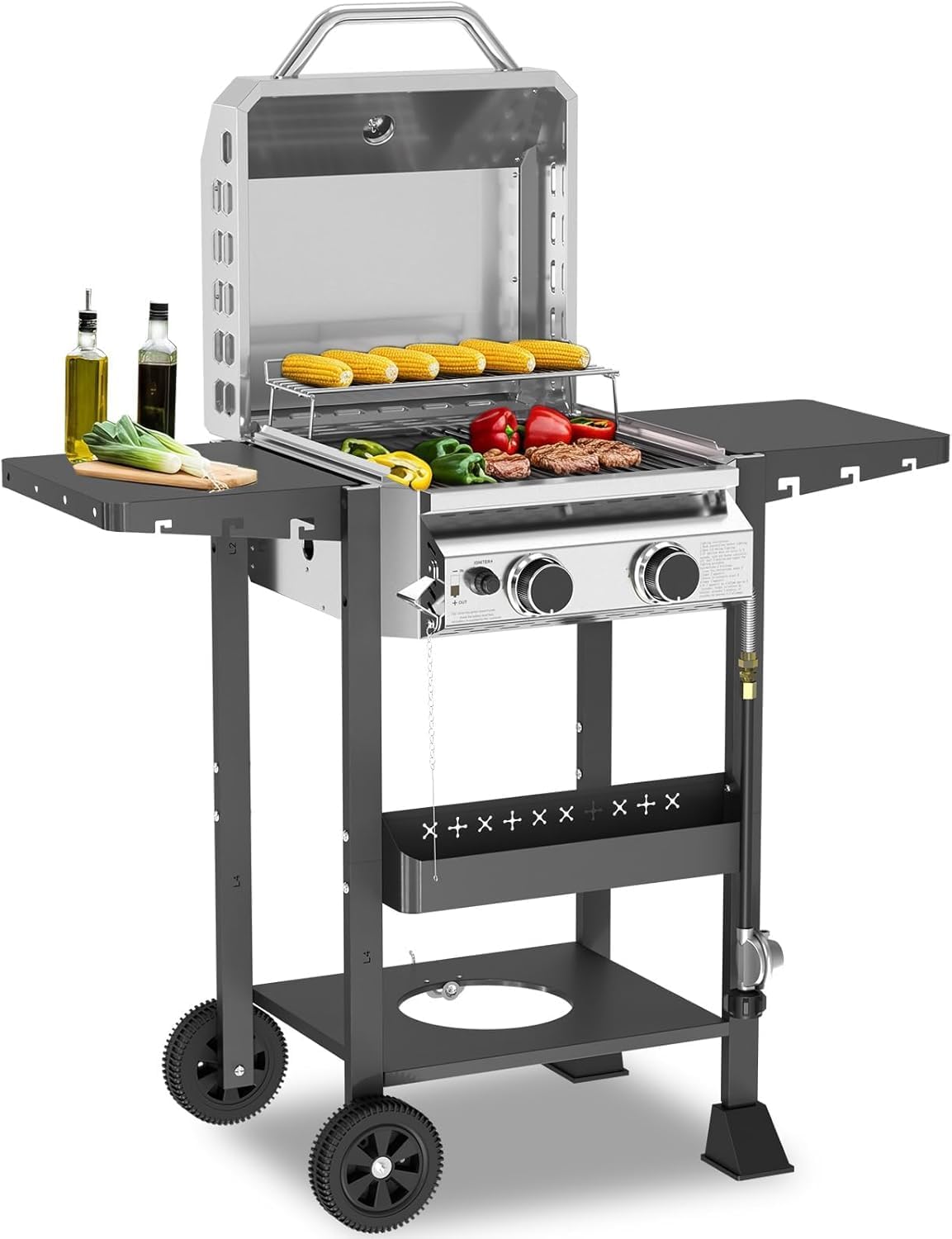
COWSAR 2-Burner Propane BBQ Grill, 16000 BTU Stainless Steel
Smallest footprint here, simplest to live with, two-zone cooking if you set it up right
16,000 BTU is thin for crusting a steak, and there is no side burner or extra grate room
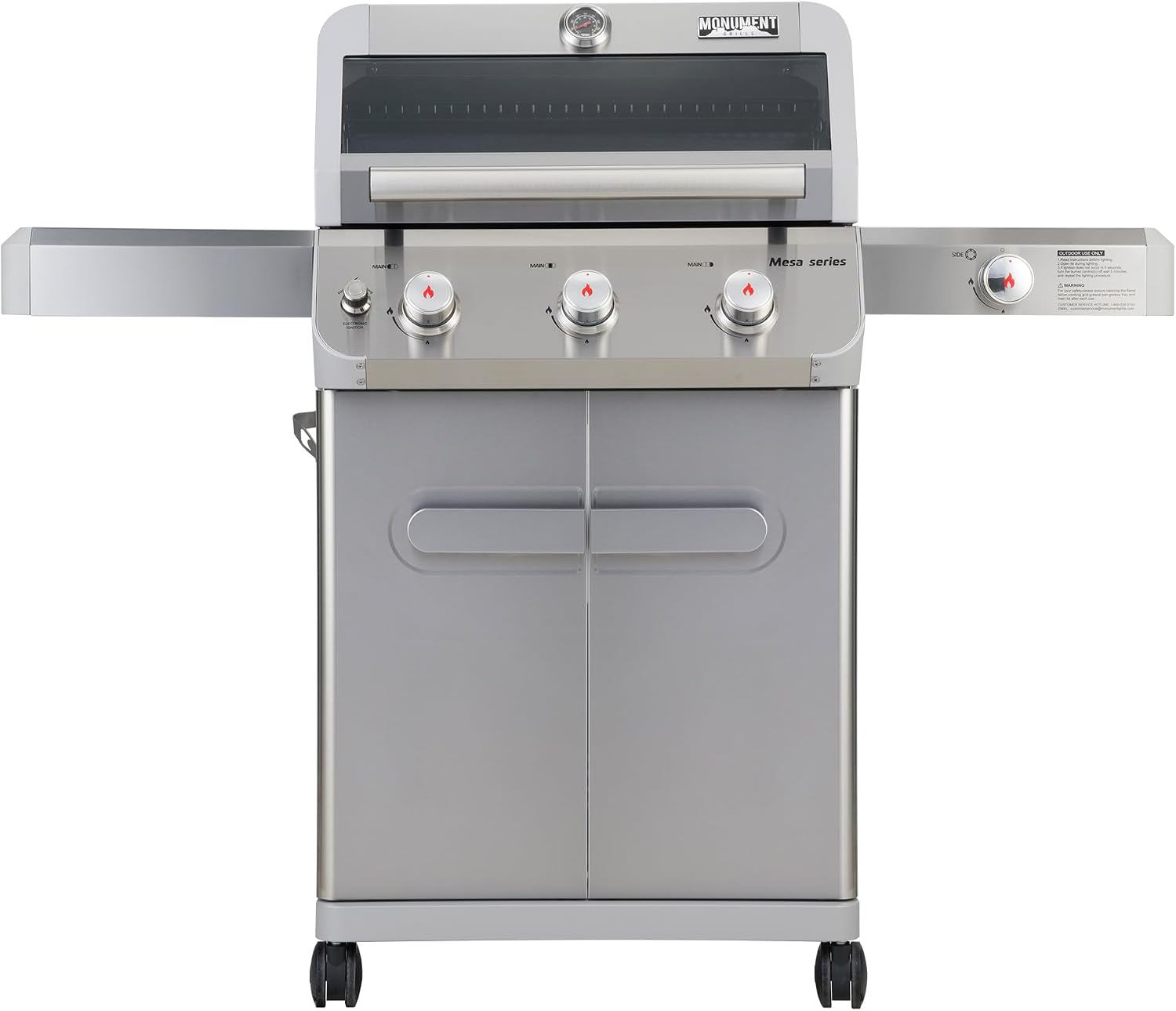
Monument Grills Mesa Series 3+1 Stainless Propane Gas Grill
Three main burners plus a side burner, 48,000 BTU spread across real zones, knob controls
Bigger cart to assemble and store, and you are paying for a full patio grill
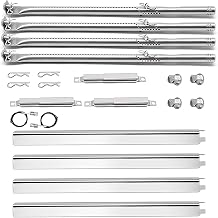
Grill Replacement Parts for Charbroil Performance 4 Burner
Cheapest way to keep a sound four-burner frame cooking for years
Only worth it if the firebox, cart, and lid are still structurally fine
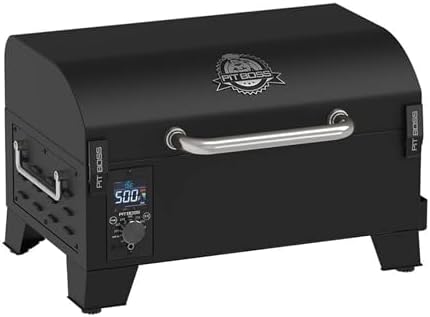
Pit Boss 150 Wood Pellet Grill & Smoker with Flame Broiler
180°F to 500°F range, 256 sq in of cooking space, 7 lb hopper, genuinely portable
Pellet discipline: hopper refills, longer starts, and it is not a sear machine for a crowd
Prices and availability were captured from Amazon Creators API and may change.
How I judge a grill before I trust it
My routine does not change with the badge on the lid. A dozen burgers across the grate, all the same thickness, to find which corner burns first. A brisket cook to see whether the thing holds temperature while the wind moves. A chicken, skin down, to see how it handles fat and whether the "flare-free" claim survives contact with actual drippings. Then three checks that have nothing to do with cooking: where the igniter sits and how it is built, how big the side tables are, and what the warranty actually covers. Paper covers parts. Steel covers the grill.
One honesty note before we go further. I have not run that full three-cook routine on every unit in this table, and I am not going to pretend otherwise. Where a unit has not had it, I judge on what is verifiable: burner count and layout, total output, cooking area, temperature range, and the parts it ships with. That is a shortlist, not a review. My full reviews take three cooks minimum, and that rule does not bend because a box showed up on my porch.
COWSAR 2-Burner: the small-space and tailgate answer
The COWSAR is the smallest idea on this list: two burners, 16,000 BTU total, stainless steel body, propane, and a footprint that will not swallow a balcony. If your patio is a landing outside an apartment door, that matters more than anything on a spec sheet.
The honest criticism is the output. 16,000 BTU is modest, and modest output means a narrow window between "nicely browned" and "steamed gray." You can work around it with a two-zone setup: run one burner and leave the other off, sear over the live side, then slide the food to the dead side to finish. That is a real technique and it works on any two-burner. What you cannot do is sear four steaks and hold a pile of corn at the same time, because there is only so much grate and only so much heat.
Where it wins is simplicity. Two knobs, no side burner to rust, no cart to assemble for an hour. For a couple, a small family, or anyone who cooks two to four portions at a time, this is the sane buy. If you routinely feed eight, this is the wrong grill and no amount of technique fixes it.
Monument Grills Mesa 3+1: the one with real heat zones
The Monument Mesa Series 3+1 is what I mean when I say layout predicts hot spots. Three main burners running left to right, plus a side burner, 48,000 BTU across the whole thing, stainless steel, knob controls, propane. That is a normal, sensible patio grill configuration, and the extra burner is the difference between cooking and juggling.
Here is the practical version. Three main burners let you run a hot zone on the left, a medium zone in the middle, and nothing on the right, so you always have somewhere to move food that is running ahead of schedule. That is the whole game with gas. The side burner is the part people dismiss and then use constantly: a sauce pan, a cast iron skillet for onions, a griddle insert for smash burgers while the main grate handles the patties.
The trade-offs are physical. It is a full-size cart, so it needs real patio space and probably two people for assembly. It costs more than the compact option, which is fair, because you are buying grate area and burners rather than a badge. And because it is a propane grill with three tubes and a side burner, igniter quality is the thing I would check first. An igniter that dies in season one is my least favorite failure in this entire category, and it is the reason I always read the warranty terms before I get excited about BTU numbers.
BTU is marketing. Even heat distribution is engineering. 48,000 BTU is not impressive on its own. 48,000 BTU spread across three burners and a side burner, in a body that holds temperature, is a working grill.
Pit Boss 150: the one that is not really in this fight
I will be straight with you: pellet smokers are the smoker bench's job, not mine. My boundary is charcoal and gas, and I send people elsewhere for pellet reviews. But the Pit Boss 150 is in this table, so here is what it is and who it is for.
It is a wood pellet grill and smoker with a flame broiler, 256 square inches of cooking space, a temperature range of 180°F to 500°F, and a 7 lb pellet hopper, built for tailgating, camping, or travel. Read that spec list the way a cook reads it. The bottom of the range, 180°F, is where you smoke and hold. The top, 500°F, is where you can get a decent sear over the flame broiler, but it is not the same as a gas grate running wide open, and it takes longer to get there.
What it does well is flavor and unattended time. Pellets give you smoke without babysitting a fire, and 256 square inches is plenty for a pork butt, a couple of racks, or a spatchcocked bird. The 7 lb hopper is the number to think about honestly: a long cook will eat through it, so bring a bag. And it is portable enough that the tailgate plan is real rather than aspirational.
What it does badly is the thing gas grills are built for: a fast weeknight sear for a crowd. Two zones of burgers in 12 minutes is not this machine's job. If you want one cooker that does everything, this is not it. If you want a second cooker that adds smoke, it earns its space.
The Charbroil rebuild kit: the cheapest grill you will ever own
This one is not a grill. It is a box of parts for a Charbroil Performance 4-burner, and it is the most interesting entry in the table because it answers the question in the title. The kit includes a G327-2100-W1 burner, G325-0002-W1 and G428-5102-W1 heat tents, igniters, and a crossover tube, and it fits the Performance 4-burner models 463354021, 463365522, 463353021, 463351021, and 463351221.
Now the reasoning. On a gas grill, the parts that fail first are the burner tubes, the heat tents above them, and the igniter. Not the firebox, not the lid, not the cart, usually. Burners rust through at the pinholes and start giving you an uneven flame. Heat tents rot out and stop protecting the tubes from drippings. The igniter quits in season one, which is why I keep a long lighter in the drawer like a grown adult. The crossover tube is the small piece that carries flame from burner to burner, and when it clogs or corrodes you end up lighting each burner by hand.
So if your four-burner still has a solid firebox, a lid that closes, and a cart that does not wobble, this kit is the difference between a grill that cooks unevenly and a grill that cooks like new. That is the repair path, and it is dramatically cheaper than replacing the whole unit. The kit is not a fix for a rusted-through firebox or a cracked cart. At that point you are putting new parts into a dead body, and you should buy the Monument instead.
What the table cannot tell you
Spec tables are useful and incomplete. Here is what I check that never makes it into a product name.
Igniter design. A piezo push button versus a battery ignition versus a simple turn knob matters less than placement. If the igniter electrode sits where grease and ash collect, it will fail. If it is shielded and reachable, it will last. Nobody puts this in a listing.
Side table size. If the side table is smaller than a plate, it is decoration. You need room for a tray, tongs, and a resting plate, or you will be balancing raw chicken on the lid.
Recovery time. How fast a grill comes back to temperature after you open the lid is the most honest spec there is, and almost nobody publishes it. Thin steel and wide-open airflow recover slowly. Heavier bodies with tighter lids recover fast. This is why I cook a brisket on a new unit before I trust it with anything expensive.
Warranty terms. Burners covered for 10 years is worth more than any logo on the hood. Read what is excluded, especially the igniter and the firebox, because those are the two things that actually fail.
Where the hot spot lives. Every grill has one corner that burns everything. On a two-burner it is usually front-left. On a three-burner it is often the far right. You find it on cook one and you cook around it forever.
Who should buy what
Small patio, two to four people, tight budget: the COWSAR. Two zones, small footprint, no wasted metal.
A real patio and a family that eats outside: the Monument Mesa 3+1. Three burners plus a side burner is the configuration that stops you from fighting the grill.
You want smoke, not speed, and you travel with it: the Pit Boss 150. Buy it as a second cooker, not a replacement for gas.
Your existing four-burner Charbroil is structurally sound but cooking badly: the rebuild kit. New burners, heat tents, igniters, and crossover tube, and you are back in business.
What I am testing next
Flare-up control. Four brands have sent me grates in 2026 with "flare-free" printed somewhere on the packaging, and I have been cooking chicken thighs on all four to see which claim survives rendered fat. So far, one out of four is telling the truth. That report will include recovery times and the actual hot spot locations for each unit, because that is the information that changes how you cook, and it is the information a brochure will never give you.
Until then: buy the grill that matches the cooking you actually do, not the cooking you imagine doing at a showroom. That one decision saves more money than any sale price.