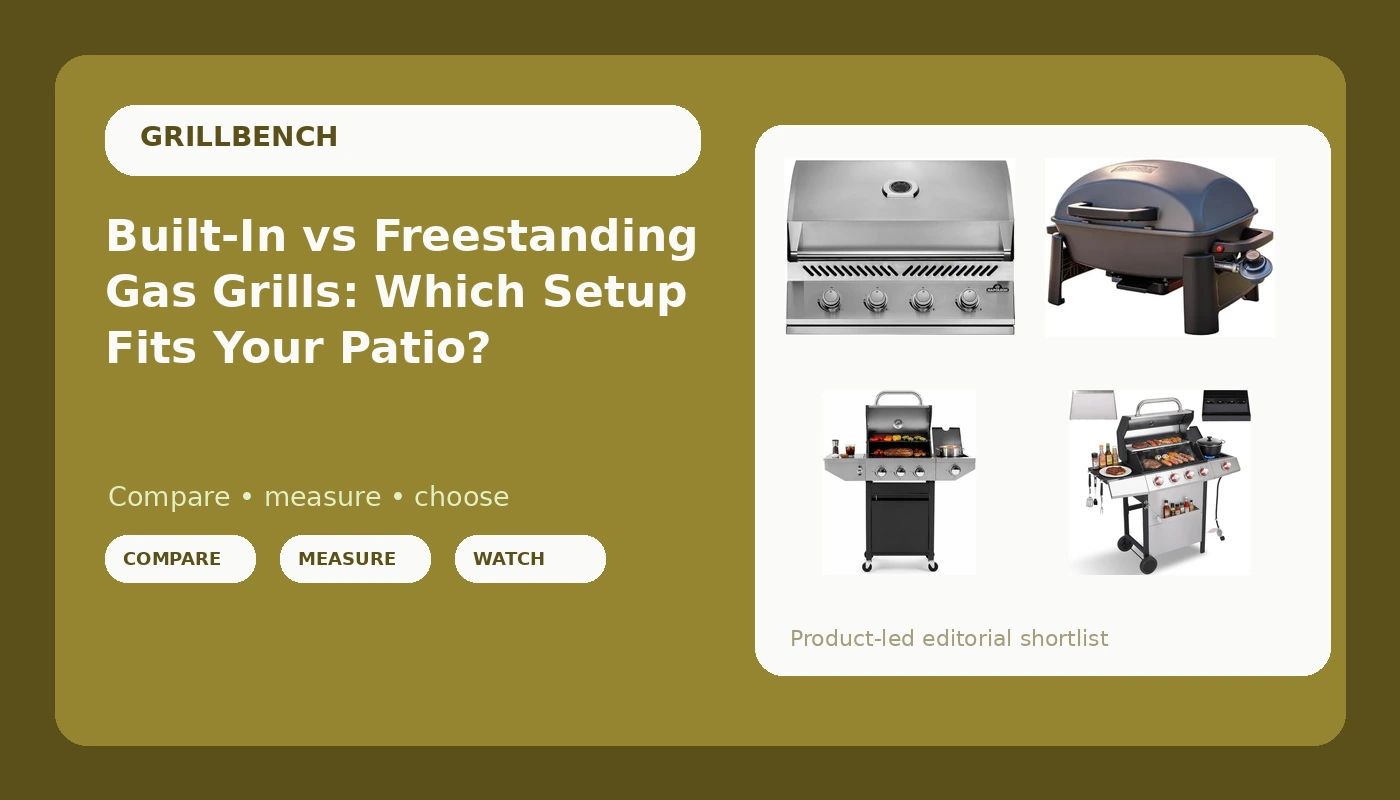
Most shoppers start with burner count and work backward. The better order is to decide where the grill will actually live, then pick the hardware that fits that space. That is why the built-in vs freestanding gas grills question comes first: a built-in head needs a cutout, a supporting structure, ventilation, and usually a permanent natural gas line, while a freestanding cart grill needs nothing more than a level slab and a propane tank. Get the mount wrong and no amount of BTU will rescue the setup. This piece walks through four different gas cooking setups, from a 32-inch built-in head to a single-burner tabletop, and explains what each one asks of you before the first cook.
Related: Burner Layouts and Hot Spots: Reading a Grill Before You Buy →
Quick answer
There is no single best configuration, only the one that matches your space and your fuel supply. A built-in head, like the Napoleon Built-In 500 Series, is designed to drop into a non-combustible island cutout and run on natural gas. A freestanding cart grill, like the Endark 3-burner or the 4-burner gas and charcoal combo, stands on its own and rolls where you need it. A tabletop single burner, like the Nexgrill, is the answer when you have a balcony, a tailgate, or a patio with no room for a full cart. Decide the mount first, then the burner count, then the fuel.
4 useful options
| Model | Best fit | What stands out |
|---|---|---|
| Napoleon Built-In 500 Series 32-Inch Built-In Gas Barbecue Grill Head | Outdoor kitchen islands with a cutout | Marine grade stainless steel, natural gas, four main burners, 7.5 mm stainless steel grids, dual level stainless steel sear plates |
| Gas and Charcoal Grill Combo with Side Burner | Cooks who want gas convenience plus a charcoal section | 49,000 BTU, four propane burners, griddle, side burner, porcelain-enameled cast iron grates, double-wall insulated lid |
| Endark 3-burner propane grill | A patio cart grill on a modest footprint | 37,000 BTU, side-fire function, stainless steel body, enameled cast iron grate, thermometer, wheels |
| Nexgrill Tabletop 1 Burner Gas Grill | Balconies, campsites, tailgates | Compact single burner in a cast aluminum frame |
The built-in head: Napoleon Built-In 500 Series 32-Inch Built-In Gas Barbecue Grill Head
A built-in head is the most demanding of the four, because the grill is only half the purchase. The other half is the island: a cutout sized to the head, framing that can carry the weight, clearance to combustibles, and ventilation so heat and gas have somewhere to go. The payoff is a cook surface at counter height with no cart to bump into, which is why outdoor kitchens are built around heads rather than carts. Natural gas means no tank swaps, but it also means a plumbed line and a licensed connection. If you rent, move often, or have no gas stub at the patio, this mount is the wrong tool no matter how good the steel is.
The gas and charcoal combo: Gas and Charcoal Grill Combo with Side Burner, 4-Burner Propane Grill and Griddle Combo
Combos solve a real argument: one person in the house wants the convenience of a knob and a timer, another wants coals. The trade-off is that you get less of each. The gas side has to share cart space with the charcoal side, so the grate area on each is smaller than a dedicated unit of the same footprint, and a double-wall lid that helps hold heat on the gas side also means more mass to manage when you are chasing charcoal temperatures. A side burner and a griddle are genuinely useful, but they are also more surfaces to clean and more ignition points to maintain. Buy it if the two-fuel setup is the point. Do not buy it as a substitute for a full-size gas grill.
The freestanding three-burner: Endark 3-burner propane grill
This is the shape most people picture when they hear gas grill: a cart, a tank underneath, wheels, and a lid. Three burners is the practical middle. It is enough to run a two-zone setup, with the left burner low for holding and the right burner high for searing, and it is small enough that preheating does not waste a tank. The side-fire function adds a burner off the main chamber, which is handy for a sauce pot or a cast iron pan, though it also adds a spot that collects drips. A lid thermometer reads at the top of the dome, not at the grate, so treat it as a trend line rather than a target number. For a patio with a level surface and no gas stub, a cart like this is the least complicated way to start cooking.
The tabletop single burner: Nexgrill Tabletop 1 Burner Gas Grill
One burner means one heat zone, and that single fact dictates the menu: burgers, sausages, skewers, a couple of steaks, vegetables in a pan. What you give up in capacity you get back in logistics. There is no cart to store, no tank to haul if you run it on a small cylinder, and nothing to level. Cast aluminum keeps the frame light enough to carry to a car. The limits are real, though. A tabletop sits low, so it is closer to wind, and the lid is close to the grate, which makes indirect cooking awkward. If you cook for two on a balcony or grill at a tailgate six times a year, this class of grill covers it. If you feed a family on a Sunday, it will run out of room before it runs out of gas.
Prices and availability may change. Product images, names, and retailer links are matched to verified listings. No current price, rating, stock status, or measured result is stated here without current evidence.
What burner count and BTU ratings actually tell you
BTU is a fuel input rating, not a promise about the temperature at the grate. It tells you how much gas the burners can consume in an hour. How much of that heat lands on your food depends on burner shape, grate mass, the distance between burner and grate, and how well the lid holds heat. That is why a 49,000 BTU four-burner and a 37,000 BTU three-burner can feel similar per burner while behaving very differently under a lid. Divide total BTU by burner count to get a rough per-burner figure, then stop treating the total as a score.
Grate material matters just as much. Thick cast iron, enameled or bare, stores heat and gives it back when cold food hits the surface, which helps a sear. Thinner stainless grids respond faster to knob changes but drop temperature harder under a load. Neither is automatically better. They are different tools for different cooking styles.
Burner layout predicts hot spots better than any spec on the box. Straight tubes running front to back tend to leave the outer edges and corners cooler. Burners arranged in an H or a U spread heat more evenly across the middle. A thermometer mounted in the lid reads the air at the top of the dome, not the air an inch above the grate, so the number you see and the temperature you cook at are two different things. A grate-level probe is the honest instrument.
How the mount changes the cook
A built-in head trades mobility for integration. It lives at counter height, which is easier on your back and lets you slide a tray from grill to prep space without lifting. In exchange, the island is permanent, service access has to be planned, and clearance to combustible framing has to be respected. Most built-in heads are also sold without a cart, so the structure cost sits on your side of the ledger. Natural gas is a luxury in the sense that it never runs out mid-brisket, but it is also a fixed utility: once the line is in, the grill stays put.
A freestanding cart trades integration for flexibility. It brings its own side tables, its own tank storage, and its own wheels. You can move it out of the wind, roll it under a cover, or take it with you when you move. The cost is that everything sits at cart height, and the cart itself is one more thing to keep clean and level.
A tabletop trades capacity for placement. It fits where a cart cannot, which is the entire reason it exists. The compromise is grate area, wind exposure, and a lid so close to the grate that two-zone cooking is difficult.
- Measure the space and decide the mount before you look at models. Cutout, slab, or tabletop is the first fork in the road.
- Settle the fuel. Natural gas requires a plumbed line and a connection you should not improvise. Propane requires tank storage and refills.
- Match burner count to the people you actually feed, not the party you imagine hosting.
- Look at grate material and thickness, then look at burner layout for hot spot risk.
- Plan the accessories at the same time: cover, grate-level thermometer, tools, and a spare igniter if the design allows one.
What to check before you buy
- Measure the cutout, the slab, or the tabletop surface, and confirm the unit is sold as a head only or with a cart.
- Confirm the fuel type in the listing. Natural gas and propane versions are not interchangeable without a conversion kit.
- Read the clearance requirements for combustible surfaces, especially for a built-in island.
- Check what the warranty covers and for how long, particularly burners and the firebox, and who handles service in your area.
- Budget for the extras that are not in the box: a cover, a tank or a gas line, and a thermometer you can place at grate level.
Which option should you choose?
Choose the Napoleon Built-In 500 Series 32-Inch Built-In Gas Barbecue Grill Head when you are building or remodeling an outdoor kitchen, you have a natural gas stub or a plan to add one, and you want a cook surface at counter height with no cart in the way. Choose the Gas and Charcoal Grill Combo with Side Burner when the household genuinely wants both gas and charcoal, and you would use a side burner and a griddle often enough to justify the shared footprint. Choose the Endark 3-burner propane grill when you want a straightforward cart grill on a patio, with two-zone cooking and a side-fire burner, and no gas line in sight. Choose the Nexgrill Tabletop 1 Burner Gas Grill when space is the constraint, whether that is a balcony, a campsite, or a tailgate, and you cook for one or two.
The caveat is that none of these decisions can be made from a spec sheet alone. BTU totals, burner counts, and grate thickness describe hardware, not results, and the same grill behaves differently in Austin wind than in a sheltered courtyard. Buy for the mount and the fuel you can actually support, then learn the hot spots on your own unit with a batch of burgers and a notebook.
The bottom line
Built-in vs freestanding gas grills is a question about your patio, not about the grill. A built-in head rewards a permanent outdoor kitchen with counter-height cooking and an endless fuel supply, provided you can build the island and plumb the line. A freestanding cart grill asks for almost nothing except a level surface, and it can move when the wind shifts or the lease ends. A tabletop covers the small-space and portable cases that neither of the others can. Pick the mount, confirm the fuel, then choose the burner count that matches the number of people you feed most weeks. Check current Amazon price on the models that fit your space, and read the warranty before you commit, because the parts that fail first are usually the ones the marketing copy never mentions.