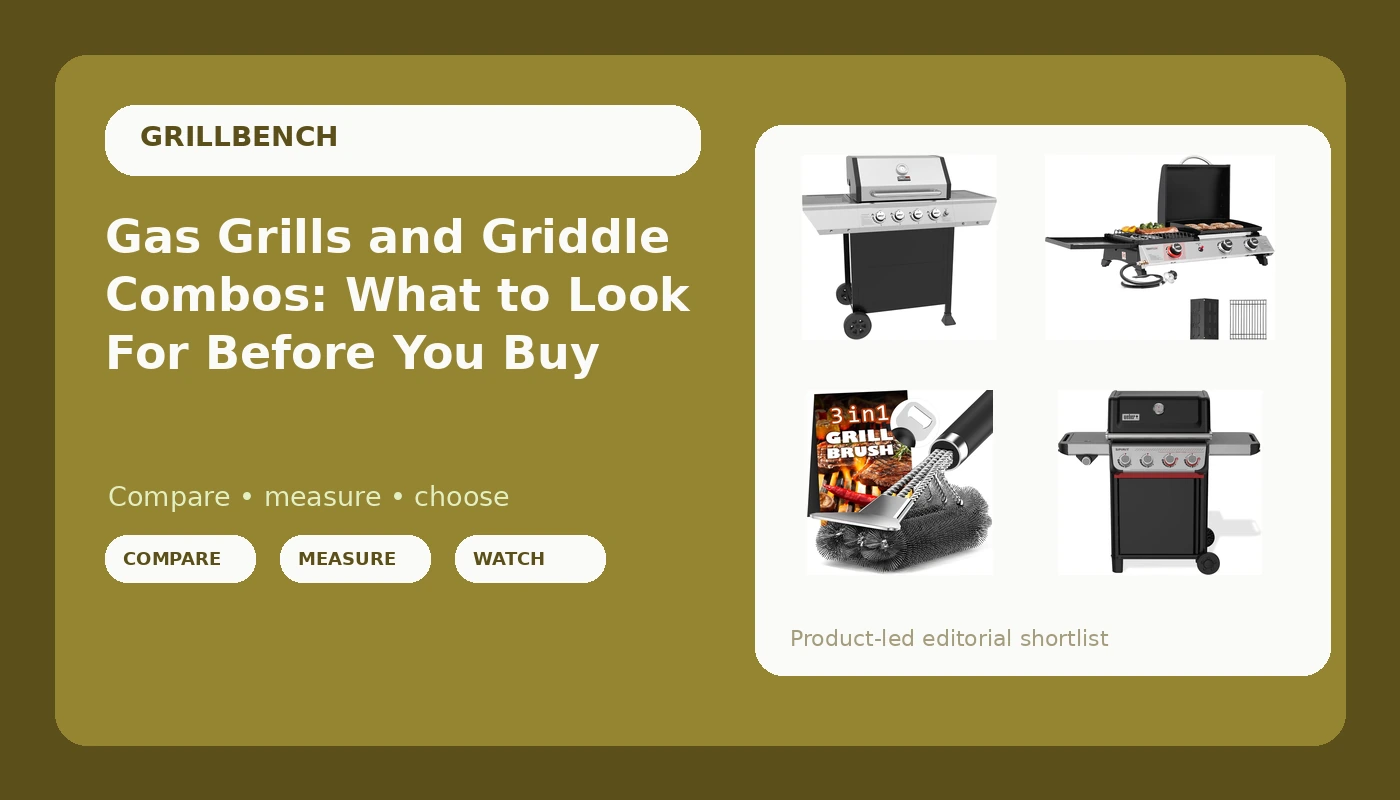
Gas grills and griddle combos sit on the same shelf and get sold with the same promises, yet they cook very differently once the lid closes. A four-burner propane grill with a warming rack, a three-burner combo built around a flat top, an 18-inch brush and scraper, and a name-brand Spirit model all solve separate problems. The one worth your money depends on what you cook in a normal week, not on which listing prints the largest number on the box. This explainer goes through what each of these four listings is actually for, where the trade-offs sit, and how to decide without paying for features you will never touch.
Related: Weber Spirit vs Royal Gourmet: How Burner Layout Changes Your Cook →
Quick answer
For a household or a small crowd that wants the most grate area for the money, the Royal Gourmet 4-Burner Propane Gas Grill with Warming Rack is the direct pick. If your weeknight cooking runs toward smash burgers, breakfast, and vegetables on a flat surface, the Royal Gourmet PD1305H 3-Burner Propane Gas Grill, Griddle Combo with Lid is the shape that fits. The Grill Brush and Scraper with the adjustable 18-inch handle is the maintenance piece that keeps whichever grill you buy working, and the Weber Spirit E-435 is the one to weigh when published warranty coverage and long-term parts support matter more to you than the lowest entry cost.
4 useful options
| Model | Best fit | What stands out |
|---|---|---|
| Royal Gourmet 4-Burner Propane Gas Grill with Warming Rack, Black & Silver | Cooks who want a wide grate and two heat zones | Four burners plus a warming rack in a conventional propane layout |
| Royal Gourmet PD1305H 3-Burner Propane Gas Grill, Griddle Combo with Lid | Flat-top cooking under a lid | Griddle surface combined with a covered three-burner body |
| Grill Brush and Scraper, 18-Inch Adjustable Handle | Anyone who wants grates to last | Long handle, scraper edge, listed as safe for gas and charcoal grates |
| Weber® Spirit® E-435 Gas Grill for Outdoor Cooking, Liquid Propane, Black | Buyers planning to keep one grill for years | Spirit-line build with published warranty terms and parts support |
The full-size workhorse: Royal Gourmet 4-Burner Propane Gas Grill with Warming Rack, Black & Silver
Burner count is the number that changes how you cook, not how you brag. Four burners let you run two lit and two off, which gives you a sear zone on one side and a holding zone on the other. That is the setup you want for a reverse sear, for chicken pieces that need to finish slowly, and for anything where one flare-up would ruin the whole cook. The trade-off with a wide body is heat-up time and recovery time: more steel and more grate take longer to come back to temperature every time you open the lid, so a four-burner grill rewards cooks who plan ahead and punish cooks who stand there flipping with the lid up. The warming rack is a holding shelf, not a cooking surface. Treat it as a place to park finished food, not as extra grate area.
The griddle-first combo: Royal Gourmet PD1305H 3-Burner Propane Gas Grill, Griddle Combo with Lid
A flat top and a grate are not competing versions of the same thing; they cook differently. A grate gives you direct radiant heat and lets fat drip away, which is why steaks and sausages taste like grilled food. A griddle gives you surface contact, which is why smash burgers get a crust across the whole patty and why onions, peppers, and eggs behave. Fat and residue stay on the plate instead of dropping into the burners, so flare-ups work differently here, but you inherit a scraping job after every cook. If your household eats breakfast outside as often as dinner, the griddle combo earns its space. If you mostly cook thick steaks and bone-in chicken, you will miss the grate.
The maintenance piece: Grill Brush and Scraper, 18-Inch Adjustable Handle
The best time to clean a grate is while it is still warm, and that is exactly when a short handle becomes a problem. Eighteen inches of reach lets you work the surface without leaning over live burners. The scraper edge handles the carbon buildup that a brush alone will not move, and the adjustable handle helps when you are working at an angle or hanging the tool on a hook afterward. Two habits matter more than the tool: brush while the grate is hot, and inspect the brush head regularly. A worn or shedding brush gets replaced, not repaired, because loose bristles on a cooking surface are a real hazard. This is also the item that keeps a four-burner grill and a griddle combo working the same way, which is why it belongs in the same conversation as the grills themselves.
The long-haul choice: Weber® Spirit® E-435 Gas Grill for Outdoor Cooking, Liquid Propane, Black
Warranty coverage is the least exciting line on a spec sheet and the one that decides whether a grill is still cooking in year eight. Burners, firebox, and lid are the components that fail first, and the terms that cover them are worth more than any badge on the front panel. Parts availability matters just as much: a grill you can still buy a burner tube for in five years is a different purchase than one that becomes scrap when a single part dies. The honest trade-off is cost. You pay more up front for the Spirit than for a budget four-burner, and the difference buys you service life and support rather than extra grate area. If you replace grills every three or four years, that math does not work for you. If you keep one until it wears out, it usually does.
Prices and availability may change. Product images, names, and retailer links are matched to verified listings. No current price, rating, stock status, or measured result is stated here without current evidence.
Burner layout tells you more than the BTU number
Total BTU is the easiest spec to print and one of the least useful on its own. What matters is how those BTUs are distributed: how many burners there are, how long each one runs, and how far apart they sit. Four burners across a wide firebox can still leave a cold corner if the spacing is uneven, and a three-burner body with tight spacing can hold a more consistent temperature across the grate than a bigger grill with gaps between tubes. The number worth paying attention to is BTU per square inch of cooking surface, not the total on the box.
The other honest measurement is recovery time, which is how quickly the grill climbs back to temperature after you open the lid. A heavy firebox and thick grates recover slowly but hold steady; a thin body spikes and drops. Neither is automatically better. Slow recovery suits long cooks and roasts. Fast response suits quick weeknight cooking where you are in and out. What you want to avoid is a grill that cannot hold a steady temperature without you standing over it, because that is not a grill, it is a fire pit with a lid and a handle.
Grate material is the third variable. Cast iron holds heat and sears hard but wants oil and attention. Stainless resists rust and cleans faster but heats unevenly until it is fully warmed. Whichever you choose, the routine is the same: preheat with the lid down, let the grates come to temperature, and only then start cooking.
What a griddle combo changes about your week
A griddle does not replace a grate; it covers a different menu. Flat-top cooking handles anything small, wet, or fragile: eggs, diced vegetables, fish fillets, and thin patties that would fall apart through a grate. Because fat stays on the plate, you get a different kind of browning and far fewer flare-ups, but you also get a surface that needs scraping while it is still warm, before residue sets hard.
The lid on a griddle combo is more useful than it looks. Trapping heat over a flat top lets you melt cheese, steam a pile of onions, and finish thicker items without flipping them constantly. It also shortens preheat time and keeps wind off the surface, which matters on a patio where gusts pull heat away from an open top.
The practical cost of a griddle is maintenance time. You will scrape, wipe, and oil a flat top after most cooks, and you will do it while the surface is hot. If that routine sounds like a chore rather than part of the ritual, a grate-based grill is the better fit for your household. If you already cook on cast iron indoors, you will recognize the rhythm immediately.
- Decide what you cook most weeks before you look at any listing.
- Count your usual portions, then pick a grate size that fits them with room to spare.
- Choose flat top, grate, or both based on whether your food is small and fragile or thick and searable.
- Check the burner count and spacing against the heat zones you actually use.
- Read the warranty terms for burners, firebox, and lid, and confirm parts are still sold.
Practical guidance for the first month
- Burn off a new grill with the lid closed before the first cook, then brush the grates while they are warm.
- Learn the hot spots on your own unit on cook one, and write down where they are.
- Run two zones whenever you can: one side hot for searing, one side low for holding.
- Keep the lid down between flips so the chamber recovers, and resist the urge to hover.
- Brush and scrape after every cook, not before, and replace a shedding brush immediately.
- Store propane safely and check the connection with soapy water before the season starts.
Which option should you choose?
Choose the Royal Gourmet 4-Burner Propane Gas Grill with Warming Rack, Black & Silver when you want maximum grate area and two-zone cooking at the lowest entry cost. Choose the Royal Gourmet PD1305H 3-Burner Propane Gas Grill, Griddle Combo with Lid when your menu runs to smash burgers, breakfast, and vegetables that need a flat surface with a lid over it. Choose the Grill Brush and Scraper, 18-Inch Adjustable Handle when you want to protect whichever grill you already own, and choose the Weber® Spirit® E-435 Gas Grill for Outdoor Cooking, Liquid Propane, Black when you plan to keep one grill for a decade and want published warranty coverage and parts support behind it.
One caveat: this is a buying framework, not a set of measured results. Heat distribution, recovery time, and flare-up behavior vary by unit, by fuel setup, and by wind on your patio, and the only way to know how a specific grill performs is to cook on it. Use the burner layout and warranty terms as your filter, then verify the current details on the listing before you commit.
The bottom line
The grill that works is the one matched to your actual cooking, not to the biggest number on the spec panel. A four-burner propane grill buys you space and two-zone control. A griddle combo buys you a flat surface and a lid, which is a different menu entirely. A brush and scraper buys you years of service from either one. And a Spirit-class grill buys you warranty coverage and parts support, which is what you are really paying for at that price. Pick the shape that matches your week, budget for the cleaning tool, and read the warranty before you read the marketing.