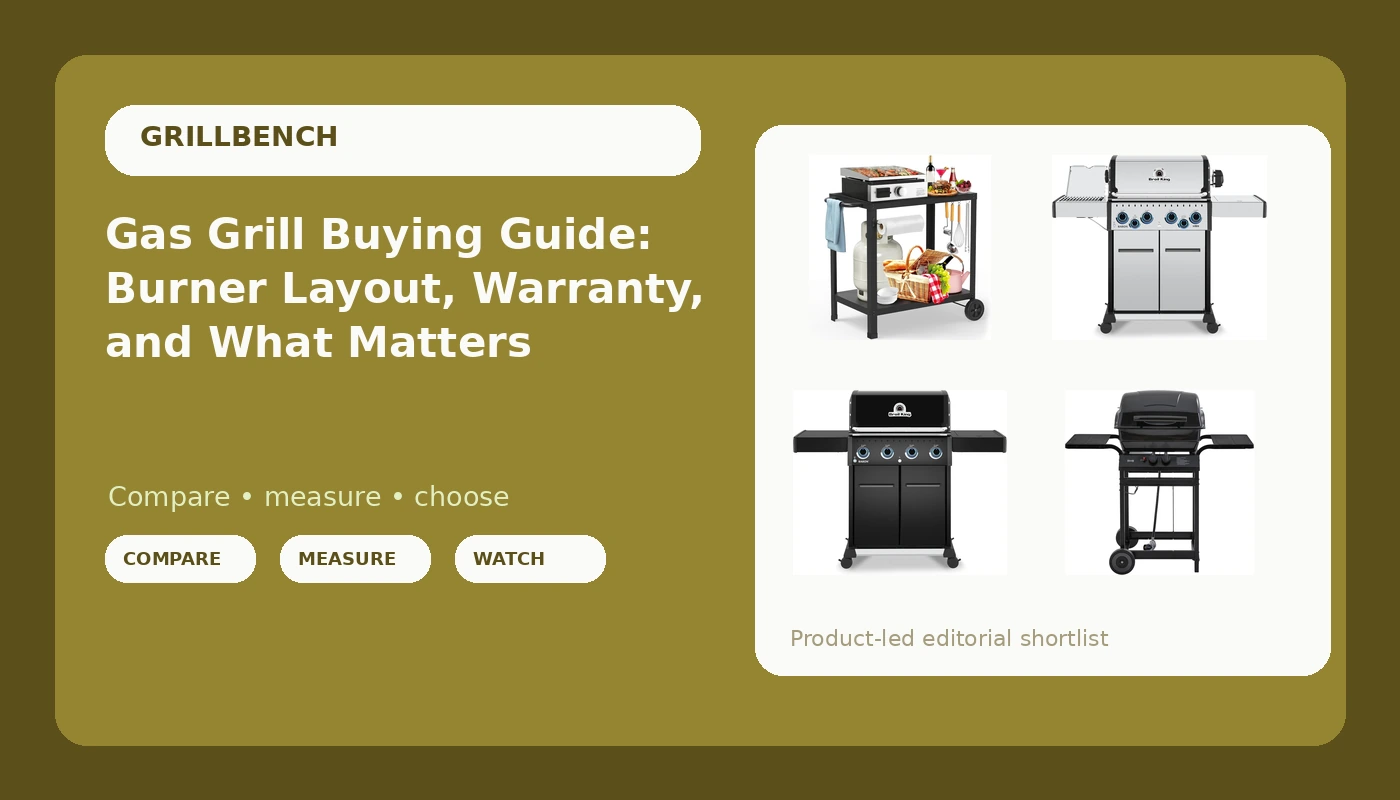
If you have spent an evening reading spec sheets, you already know what is wrong with most of what passes for a gas grill buying guide: it lists BTU numbers and calls that advice. Burner count, grate material, and a large number printed on the lid do not tell you whether a grill holds 350 degrees for an hour while you walk away and answer the door. What tells you that is burner layout, body construction, and how the fuel reaches the fire. This guide works through four options that sit in different places on that map: a compact two-burner propane grill, a four-burner propane model, a four-burner natural gas model with infrared and rotisserie burners, and a wheeled cart built to hold a griddle. Each one solves a different problem, and the right answer depends on how you actually cook rather than how you imagine you will.
Related: How to Stop Gas Grill Flare-Ups Before They Start →
Quick answer
Match the grill to the fuel you already have and the number of people you actually feed. A two-burner propane grill covers small households and small patios. A four-burner propane grill adds zone control for larger cooks. A natural gas model removes the tank swap entirely but requires a permanent gas line. A wheeled griddle cart is not a grill at all; it is the working surface that makes a flat-top setup usable. No listing can tell you how a specific unit holds temperature until you cook on it, so treat burner layout and warranty terms as the two things worth comparing closely.
Four useful options
| Model | Best fit | What stands out |
|---|---|---|
| Feasto 2 Burner Propane Gas Grill for Outdoor Cooking and BBQ, Black | Small households and tight patios | Two propane burners in a compact black body |
| Broil King 674114 Baron 420 Pro Shadow 4-Burner Pellet Ready Propane Gas Grill in Black | Cooks who want zone control on propane | Four main burners, propane fuel, described as pellet ready |
| Broil King 677347 Baron S 490 Pro IR 4-Burner Pellet Ready Natural Gas Grill in Stainless Steel with Infrared Infrared Side Burner and Rear Rotisserie Burner | Permanent outdoor kitchens with a gas line | Four burners on natural gas, plus infrared side and rear rotisserie burners |
| Yozoia Outdoor Grill Table for Griddle, Grill Cart with Wheels | Anyone running a griddle alongside a grill | A wheeled cart and table sized for griddle cooking |
Compact propane: Feasto 2 Burner Propane Gas Grill for Outdoor Cooking and BBQ, Black
Two burners is not a limitation if you cook for two or three people. It is a different style of cooking: one zone for the food, one zone for holding or finishing, a smaller body that comes up to temperature with less steel to heat, and less fuel burned per session. The trade-offs are real, though. With two burners you have fewer places to move food when a flare-up starts, and you cannot run a hot side and a cool side with much distance between them. If your typical cook is a few burgers, a couple of chicken breasts, or a weeknight dinner for a small household, this is a sensible place to start. If you regularly cook for eight people, this is not the body you want.
Mid-size propane: Broil King 674114 Baron 420 Pro Shadow 4-Burner Pellet Ready Propane Gas Grill in Black
Four burners is where a gas grill starts to behave like a real cooking tool. With four tubes you can run two hot, one medium, and one off, which gives you a place to sear, a place to finish, and a place to park food that is already done. That arrangement is what people usually mean when they talk about two-zone cooking on gas, and it is the single biggest practical jump you make when you move up from a two-burner body. The trade-offs are size and fuel draw. A four-burner grill takes longer to preheat and burns more propane per hour, and propane means a tank, which means a spare tank, which means the tank you forgot to refill on a Saturday afternoon.
Natural gas with specialty burners: Broil King 677347 Baron S 490 Pro IR 4-Burner Pellet Ready Natural Gas Grill in Stainless Steel with Infrared Infrared Side Burner and Rear Rotisserie Burner
Natural gas changes the logistics of grilling more than it changes the cooking. You stop thinking about tanks, you stop running out mid-cook, and you stop making a hardware store run on a Sunday evening. The cost is permanence: a gas line, a shutoff, and a spot on the patio that is now the grill's home. The infrared side burner and the rear rotisserie burner are the two features that separate this model from a standard four-burner. An infrared burner heats a solid element that radiates direct heat at the food, which is a different kind of energy transfer than a flame licking a grate from below. A rear rotisserie burner is aimed at the back of the chamber for turning meat on a spit. Both are specialty tools, and both are worth paying for only if you will actually use them.
Griddle cart: Yozoia Outdoor Grill Table for Griddle, Grill Cart with Wheels
A griddle is not a grill, and the surface it sits on matters more than most people expect. A dedicated wheeled cart puts the cooking surface at working height, keeps the flat-top off the main grill body so you can run both at once, and lets you roll the whole station out of the way when the cook is finished. This is the accessory category that buying guides tend to skip, because it has no burners and no BTU number to print in a comparison table. If you already own a griddle, or plan to run one next to a gas grill, the cart is the piece that turns an improvised arrangement into a workable one.
Prices and availability may change. Product images, names, and retailer links are matched to verified listings. No current price, rating, stock status, or measured result is stated here without current evidence.
How burner layout decides where your hot spots live
Burner layout predicts hot spots better than any spec on the box. A grill with straight tubes running front to back concentrates heat in bands, so the grate directly over each tube runs hotter than the gaps between them. That is not a defect; it is geometry, and it is the reason a cook who knows the layout can sear on the left and hold on the right while a cook who does not will burn one side of the food and undercook the other.
Burner count matters for the same reason. Two burners give you two zones and a narrow band of transition between them. Four burners give you four zones and much more room to build a temperature staircase, which is why four-burner bodies are the point where two-zone cooking becomes practical rather than theoretical. If a manufacturer puts the burners in a different shape, an H pattern or a single wide tube, the hot and cool areas move with it.
The other honest measurement is recovery time, which is how fast the chamber climbs back to temperature after you open the lid. Long recovery means you lose heat every time you flip a steak, and you end up cooking with the lid down and your hands off the food to compensate. A grill that cannot hold a steady temperature for an hour without babysitting is a fire pit with a lid, no matter what the BTU number says. Preheat behavior, lid fit, and how much steel sits between the fire and the food all feed into that, and none of them appear on a marketing sheet.
What the labels actually change
Fuel is the first fork in the road. Propane comes from a tank you own, refill, and eventually forget to refill; it works anywhere and needs no installation. Natural gas comes from a line, which means no tanks and no refills but also a fixed location and a connection that a qualified installer should handle. Neither fuel changes what the food tastes like in any way you will notice through a grate and a drip tray, so choose on logistics, not on flavor claims.
Specialty burners are the second fork. An infrared burner drives radiant heat into the surface of the food, which is why it is usually paired with a searing station rather than a general cooking area. A rear rotisserie burner is a narrow burner at the back wall of the chamber, positioned to hit meat turning on a spit rather than food sitting on the grate. Both are genuinely useful and both are useless if the cooking you do is burgers and chicken breasts on a weeknight.
The phrase pellet ready deserves a footnote. It appears on listings for gas grills and it does not mean the grill is a pellet grill. It means the model is marketed as compatible with pellet cooking in some configuration, and the specific hardware, whether it is included, and what it costs are questions for the manufacturer or the listing details. Do not assume a hopper is in the box.
Run the comparison in this order:
- Decide the fuel first, based on whether you have a gas line or you are willing to own tanks.
- Count the people you feed on a normal weekend, not the biggest cook you hosted once.
- Pick a burner count that gives you at least one zone you can turn off completely.
- Check what the warranty covers and for how long, because burner tubes and firebox steel are the parts that decide whether the grill lasts.
- Read the listing details on anything labeled pellet ready, infrared, or rotisserie, and confirm what is actually included.
Practical guidance before you buy
- Measure the patio space and add clearance on all sides, because a grill needs air around it and a lid needs room to open.
- Budget for a cover, a spare tank if you go propane, and a thermometer you trust more than the lid gauge.
- Check that the side tables are large enough to hold a sheet pan, not just a spatula.
- Look hard at the igniter design before you buy. An igniter that dies in the first season turns every cook into a manual lighting exercise.
- If a griddle is part of your plan, price the cart at the same time as the grill so the flat-top does not end up on a folding table.
- Confirm the warranty terms in writing rather than trusting the badge on the lid.
Which option should you choose?
Choose the Feasto 2 Burner Propane Gas Grill for Outdoor Cooking and BBQ, Black when you cook for a small household, your space is limited, and you want propane simplicity without a large cart. Choose the Broil King 674114 Baron 420 Pro Shadow 4-Burner Pellet Ready Propane Gas Grill in Black when you want four-zone control and the ability to cook for a crowd, but you are not ready to plumb a gas line. Choose the Broil King 677347 Baron S 490 Pro IR 4-Burner Pellet Ready Natural Gas Grill in Stainless Steel with Infrared Infrared Side Burner and Rear Rotisserie Burner when the grill has a permanent home, a gas line is available, and you will genuinely use an infrared sear station and a rotisserie burner. Choose the Yozoia Outdoor Grill Table for Griddle, Grill Cart with Wheels when a griddle is part of your setup and you need a surface that is built for it.
One caveat applies to all four. The details here come from the product listings, not from a test kitchen, and a listing cannot tell you where the hot spots land on a specific unit or how it behaves in wind. Verify the included parts, the fuel requirements, and the warranty coverage against the current listing before you commit, and expect to spend your first cook learning the layout of whatever you buy.
The bottom line
A gas grill purchase comes down to three decisions that have nothing to do with BTU marketing: what fuel you can actually supply, how many zones you need for the way you cook, and what the warranty covers when something fails. The Feasto two-burner covers small households on propane, the Broil King Baron 420 Pro Shadow adds four-zone control on a tank, the Broil King Baron S 490 Pro IR moves to natural gas with infrared and rotisserie burners for a permanent setup, and the Yozoia cart gives a griddle a proper home at working height. Pick the one that matches your fuel and your guest count, then learn its hot spots on the first cook. That knowledge is worth more than any number printed on a lid.